Export Documents: A Guide for SMEs

Export Documents: A Guide for SMEs

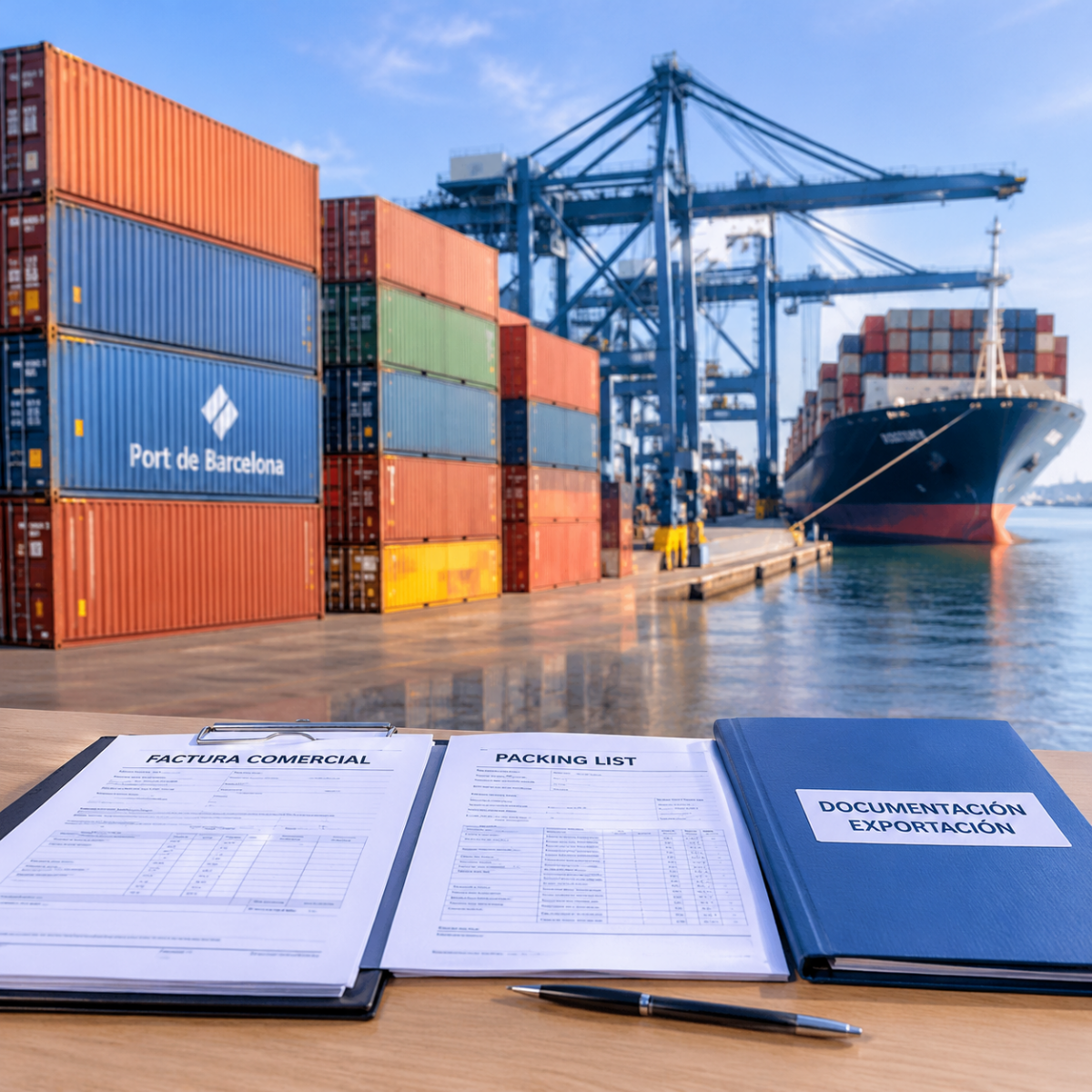
In international trade, there is one rule that never fails: if the documents do not match, the goods are stopped. An incorrect weight, a wrongly entered tariff code or a certificate that arrives late can result in a container being held up at the port or payment being blocked for weeks.

This guide summarises the export documents required by any SME taking its first steps towards internationalisation. It also reviews the most common mistakes and how to avoid them. It is based on the session we delivered as part of ACCIÓ’s Catalunya Exporta programme, together with Foment del Treball.


The four main groups of export documents

Every export transaction relies on four groups of documents:

  1. The commercial invoice
  2. The packing list
  3. Transport documents
  4. Certificates: certificates of origin, health certificates and certificates of conformity

Let’s take a closer look at each one.
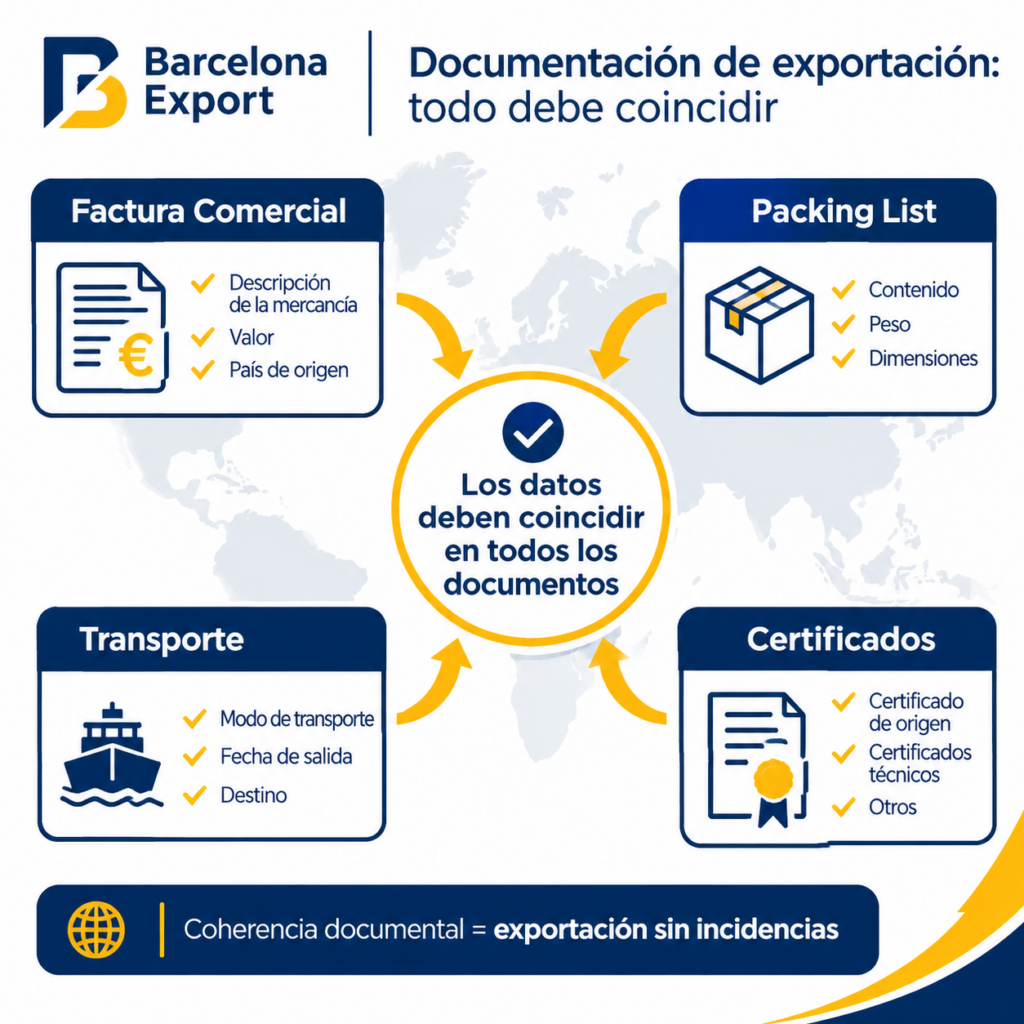

Infographic by Barcelona Export illustrating the four key export documents: commercial invoice, packing list, transport documents and certificates.

1. Export documents: the commercial invoice

This is the sales document and the basis used by the customs authorities in the destination country to calculate duties and taxes. That is why it must be complete and accurate. It should include:

  • Seller’s and buyer’s details, including their tax identification numbers and EORI numbers
  • Description and HS code of each product
  • Quantity, unit price, total amount and currency
  • Incoterm, country of origin of the goods and payment terms

The EORI number. This is the identification number assigned by customs authorities to economic operators within the European Union. It is mandatory for all customs procedures. In Spain, it consists of the prefix ES followed by the company’s tax identification number (NIF). If you do not have one yet, you can apply through the Spanish Tax Agency’s electronic office, under “EORI Procedures” (Gestiones EORI), selecting “Register for a Spanish EORI number” (Alta de EORI español).

The correct HS code. The first six digits of the HS code are the same worldwide. In the EU, the Combined Nomenclature adds two more digits, while the TARIC code contains ten digits, which determine the applicable duties and trade measures. An incorrect code can result in higher customs duties, penalties or goods being held up. To find the correct code, consult Access2Markets and the European Commission’s TARIC database.

VAT. Sales to countries outside the EU are exempt from VAT. Indicate this on the invoice and keep the export customs declaration (DUA) as proof.

The pro forma invoice. This is not the final invoice. It is used to request advance payment, open a documentary credit or apply for import licences in the destination country.


2. Export documents: the packing list

This is a detailed list of the contents of each package. It is used by the carrier, customs authorities and the customer to check the shipment. It should include:

  • Number and type of packages
  • Contents and references of each package
  • Net weight, gross weight and dimensions
  • Marks, numbering and invoice number

The key here is to make sure everything matches. Quantities and weights must be consistent across the invoice, packing list and transport document. Any discrepancy may trigger a physical inspection. In addition, each package must be marked with its number (1/4, 2/4, etc.), the consignee and the destination port, exactly as stated in the packing list.


3. Export documents: transport documents

Each mode of transport has its own document:

  • Sea freight: Bill of Lading (B/L)
  • Air freight: Air Waybill (AWB)
  • Road transport: CMR consignment note
  • Rail transport: CIM consignment note

The Bill of Lading is the most complex document because it serves three purposes at once: it is a receipt for the goods, a contract of carriage and a document of title. Whoever holds the original can claim the goods at the port. If the carrier records damage or defective packaging, the B/L is no longer considered “clean”, and the bank may reject it under a documentary credit.

For example, a company ships olive oil to New York in a 20-foot container. The sale is CIF New York, so the B/L will be issued “to order”, marked “clean on board” and “freight prepaid”, since the seller pays the freight.

The AWB and CMR are not documents of title. They function as international delivery notes: the goods are delivered to the consignee named in them. A signed CMR is also proof of delivery. For example, if a manufacturer in Girona sends furniture to Lyon by truck, the CMR signed by the customer upon unloading provides evidence of the intra-EU sale for VAT purposes.

The export customs declaration (DUA). When goods leave the EU, an export declaration must be lodged with customs. This is normally handled by the freight forwarder. The DUA identifies the exporter, importer and goods, including their value, TARIC code and destination. It confirms that the goods have left the EU and provides tax evidence of the export, for example, to justify VAT exemption.


4. Export documents: certificates

The four most common types are certificates of non-preferential origin, preferential origin proofs (EUR.1), health and phytosanitary certificates, and certificates of conformity and inspection.

Non-preferential certificate of origin. This certifies where the goods were manufactured or obtained, but does not in itself entitle the importer to any reduction in customs duties. It is issued by Chambers of Commerce and is required by certain countries and under many documentary credits. Pay attention to the wording: if the documentary credit requires a certificate of origin issued by Chamber of Commerce, a certificate issued by another organisation will be rejected.

Proof of preferential origin. This certifies that the goods comply with the rules of origin set out in an EU trade agreement, allowing the importer to benefit from reduced or zero customs duties. Depending on the agreement, this may take the form of an EUR.1 certificate, a statement of origin on the invoice or another document. For example, a company selling biscuits to Morocco may provide an EUR.1 certificate so that the buyer benefits from reduced or zero customs duties. Without it, the buyer has to pay the standard tariff, making the product less competitive.

Health certificates. These are generally required for food products and goods of animal or plant origin. They are issued by the competent authority and may take several weeks to obtain. Before selling, check Access2Markets to find out which certificates are required by the destination country for your HS code.

Legalisation. Some countries, particularly in the Gulf region and Latin America, require documents to be legalised or apostilled. Make sure you factor this into your planning.


The four most common mistakes to avoid when preparing export documents

  1. Inconsistent information. Different quantities, weights or descriptions across the invoice, packing list and B/L can hold up the goods or delay payment.
  2. Vague descriptions. Terms such as “spare parts” or “samples” are not valid descriptions. Customs authorities need to know exactly what the product is and its HS code.
  3. Failing to read the documentary credit carefully. Banks check documents word for word. Even a typo can delay or block payment.
  4. Applying for certificates too late. Health certificates, legalisations and EUR.1 certificates can take days or weeks to obtain. Request them before the goods are loaded.
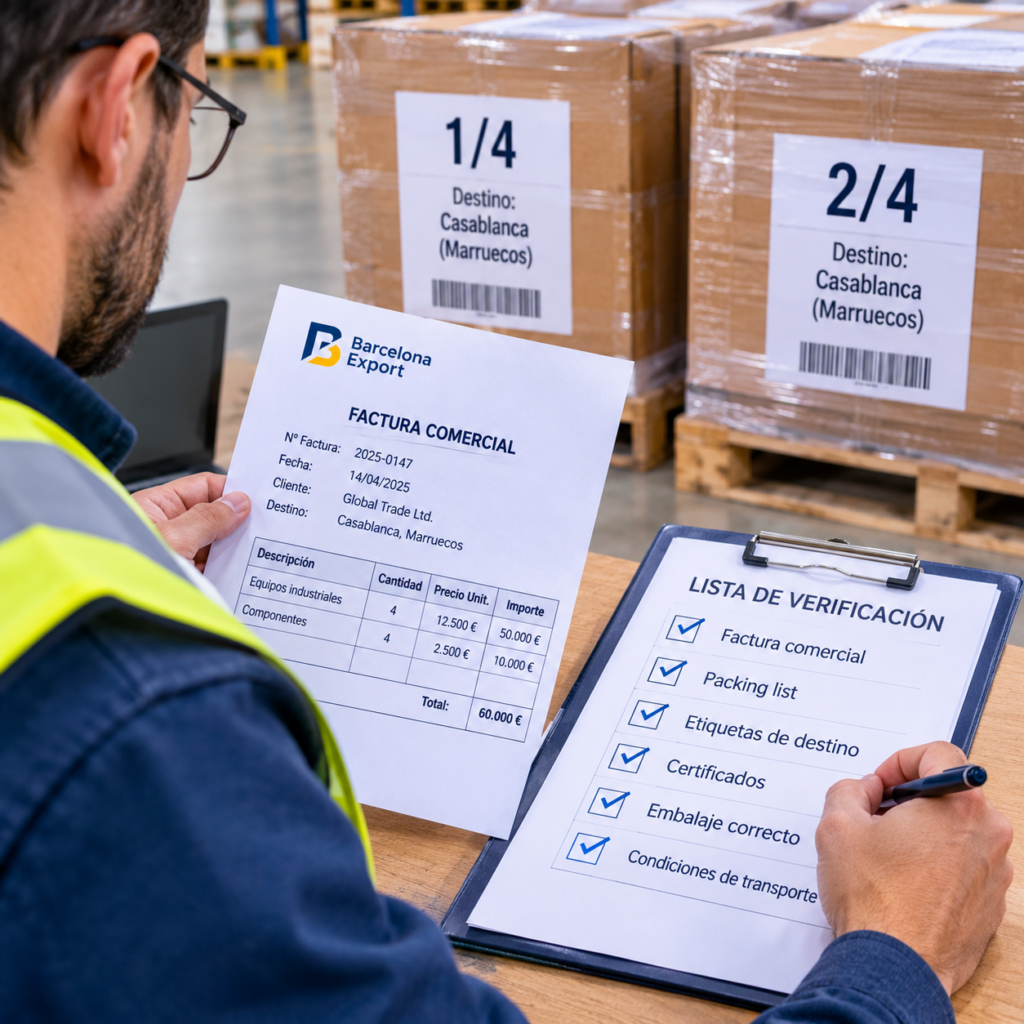
Professional reviewing a commercial invoice and a checklist alongside numbered and labelled packages for export to Morocco.

Checklist before submitting your export documents

  • HS code and product description checked
  • Consistent information across all documents
  • Same Incoterm in the quotation and invoice
  • Certificates requested and valid

Support programmes to help you start exporting

If your company is taking its first steps into exporting, you do not have to do it alone. ACCIÓ’s Catalunya Exporta programme supports Catalan companies, particularly SMEs, during the initial stages of internationalisation. The Government of Catalonia has mobilised €3 million with the aim of helping 2,000 companies start exporting over the next three years.

There are also specific support schemes available:

  • ACCIÓ vouchers for companies starting to export, worth up to €10,500 per company, and vouchers for internationalisation plans, worth up to €8,000. These grants help companies hire an international trade consultant accredited by ACCIÓ. They are aimed at SMEs with an operating base in Catalonia that export less than 25% of their turnover, recorded revenue of at least €250,000 in the previous year and have a website in at least one foreign language. Applications are assessed in order of submission and funding is usually exhausted quickly. The next call for applications is expected around May 2027.
  • International Promotion Grant, ranging from €15,000 to €30,000 per company and covering up to 50% of eligible expenditure. It funds websites and e-commerce, digital marketing in international markets, online marketplaces, trade fairs outside Catalonia, and certifications or product approvals. Applicants must have a minimum turnover of €500,000, a website in a foreign language and a current international promotion plan.

Always check the terms and conditions of each call for applications, as funding amounts and eligibility requirements may change.


Need help with your first export?

At Barcelona Export, we guide you step by step so that you can prepare your export documents without errors, delays or payment problems. Request your free personalised assessment and we will suggest an initial action plan tailored to your business.
Export Chatbots: 24/7 Support for International Clients

Boosting exports with chatbots: smart digital support for international markets

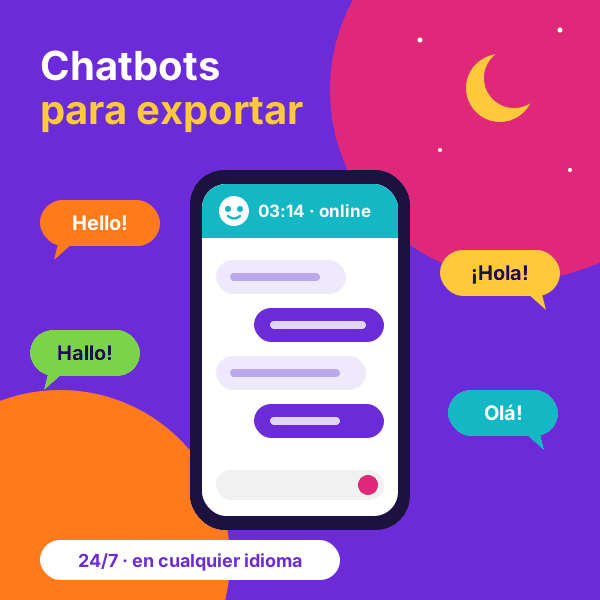
An export chatbot is an assistant that answers your international customers in their own language and at any time, using information from your own company. It does not replace your sales team: it responds, filters enquiries and provides information so that your team can focus on selling. For an SME starting to export, it can make the difference between winning a customer and losing one while you sleep.


Exporting is, above all, about responding

Imagine it is 3 a.m. in Barcelona. In Mexico City, it is 8 p.m., and a distributor messages you to request a price for two pallets. By the time you open your email at 9 a.m., they may already have contacted another supplier.

Exporting companies face four customer service challenges every day:

  • Time zones: the customer asks a question when you are unavailable.
  • Language: you speak English, but what about German or Portuguese?
  • Repetition: the same questions come in every week.
  • Uncertainty: you do not know whether the person contacting you is a serious importer or simply curious.

A good chatbot tackles all four challenges at once.


What is a chatbot (and what isn’t it)?

A chatbot is a programme that communicates with people, in writing or by voice, to answer questions or perform tasks. It can be integrated into your website, WhatsApp or your team’s internal tools. To work properly, it needs information about your company. Its role is to answer questions, ask follow-up questions and, when necessary, hand the conversation over to a person.

There are two very different types of chatbot:

  • Rule-based chatbots: they follow a predefined sequence of buttons and options. They are predictable and easy to control, but quickly reach their limits when customers go off-script.
  • AI-powered chatbots: they understand open-ended questions, phrased naturally by customers in their own language, and respond using your documents. They need clearly defined boundaries.

It is also worth understanding what a chatbot is not: it is not an animated FAQ page, it is not a replacement for your sales representative, and it does not have to be a complex technology project. A good chatbot does not know more than your company does: it has access to the same information, but can communicate it at any time and in any language.


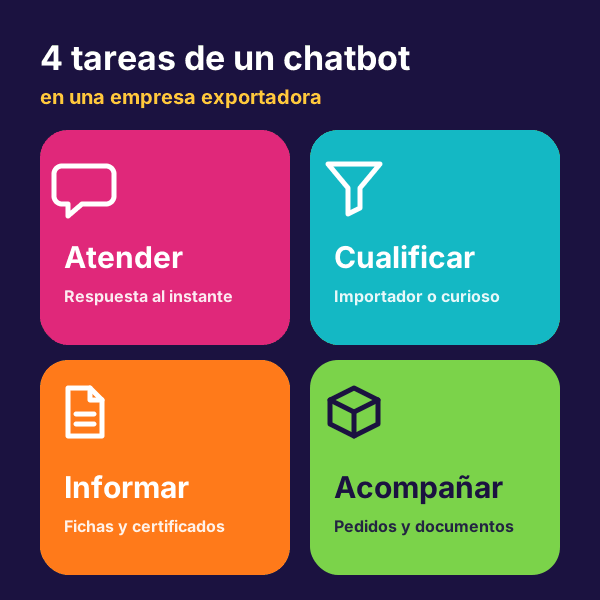
The four tasks of an export chatbot: respond, qualify, inform and support.

Four tasks where a chatbot genuinely helps

  1. Responding. It replies instantly, in the customer’s language and at the moment they ask. For example, to the question: “Do you ship to Chile?”
  2. Qualifying leads. It distinguishes a potential importer from a casual enquirer before you spend an hour on the conversation. Imagine a winery in the Penedès region receiving enquiries from Germany: the assistant responds in German, asks whether the person is an importer, retailer or restaurant, and what annual volume they need. It then passes the contact to the sales representative with a summary. The bot does not close the deal; it prepares the sales call.
  3. Providing information. It supplies precise details: technical data sheets, certificates, lead times or Incoterms. An industrial components manufacturer can use it to confirm whether its models have a particular certification, refer to the relevant technical data sheet and attach the certificate. If the information is not included in the documentation, the assistant says so and forwards the question to a technician. “I don’t know” is better than an invented answer.
  4. Supporting customers. It follows up after the sale with order status, documents or replenishment requests. When connected to the order management system and the channel your distributors already use, such as WhatsApp, it moves beyond simply answering questions and starts resolving requests.

There is a fifth option that many companies overlook: building the first chatbot for their own team. An internal assistant that can search quotations, contracts and previous emails helps prevent valuable knowledge from disappearing when an employee leaves. It also allows the team to learn and experiment without the risk of making mistakes in front of a customer.


What Klarna and IKEA can teach us

Two well-known examples demonstrate both the potential and the limitations of this technology.

In 2024, payments company Klarna launched an AI assistant that, according to the company itself, handled two-thirds of customer service chats across 23 markets and 35 languages, reducing resolution times from 11 minutes to 2 minutes. However, in May 2025, its CEO acknowledged that service quality had declined and that the company was hiring people again to serve customers.

IKEA took a different approach. Its Billie chatbot, launched in 2021, handled 47% of enquiries to its customer service centres over a two-year period. Instead of eliminating jobs, the Ingka Group trained 8,500 employees to become interior design advisers. Remote interior design services generated €1.3 billion during its 2022 financial year.

The lesson is clear: chatbots work best when they free up people’s time to sell, rather than trying to replace them.


How to get started without a large budget

You do not need a six-month project. You can progress through three levels:

  1. Respond: create a company-specific knowledge base on your website or WhatsApp that answers questions and forwards enquiries when necessary.
  2. Qualify: ask questions, register the contact in your CRM and notify the sales representative.
  3. Take action: retrieve order information, send documents or prepare draft quotations for a person to review and approve.

There are three main ways to integrate a chatbot into your website: insert a snippet of code provided by the platform, install a plugin for systems such as WordPress, Shopify or PrestaShop, or build a custom integration with your ERP or CRM.

Above all, choose the channel your customers use, not the one you personally prefer. WhatsApp is widely used in Latin America and southern Europe; WeChat is essential in China; LINE is popular in Japan, Taiwan and Thailand; and websites and email remain the foundation of B2B communication across markets.


Five rules to follow before going live

  • Never make things up: the chatbot relies on your documentation and refers the enquiry to a person if the information is missing.
  • Never make promises: prices, discounts and binding delivery commitments must always be confirmed by a person.
  • Do more than translate: a native speaker should review key messages because translation is not the same as localisation.
  • Do not collect unnecessary data: request only what is needed and comply with the GDPR.
  • Be transparent: clearly state that the customer is interacting with an automated assistant and always offer the option to speak to a person.

To measure results, forget about the number of conversations alone: more conversations may indicate greater interest, or they may mean the bot is not resolving enquiries. Track first-response times by market and time slot, the number of qualified leads passed to sales, transfers to a human representative, and unanswered questions. The latter will become your list of content gaps to address.


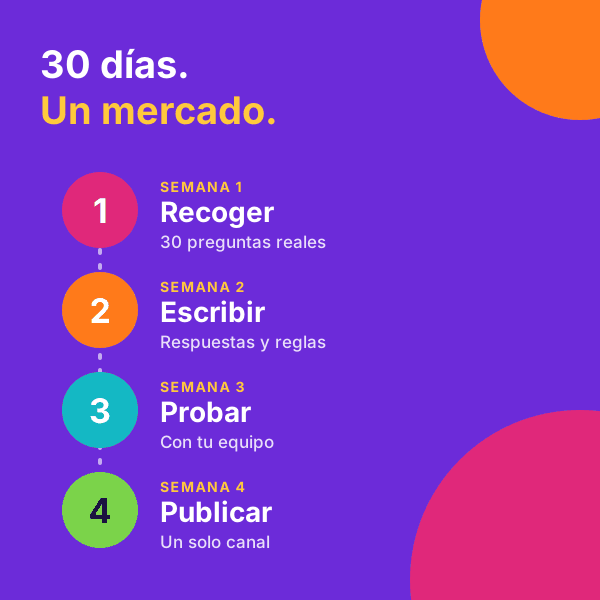
30-day plan to launch a chatbot in one market: gather, write, test and publish.


A 30-day plan for a single market

  1. Week 1 – Collect: gather the 30 real questions customers ask in one specific market. Find them in your emails rather than relying on brainstorming.
  2. Week 2 – Write: draft the answers and escalation rules with help from the people who know the product.
  3. Week 3 – Test: test the chatbot with your team and actively try to make it fail.
  4. Week 4 – Launch: activate it on a single channel and review every conversation.

Most of the work is not technical: it is about writing good answers.


Frequently asked questions

  • Does a chatbot replace the sales team? No. It responds to enquiries, qualifies leads and provides information, but commercial decisions, such as prices, discounts and delivery commitments, must always be made by a person.
  • What do I need to get started? Your company’s information (technical data sheets, catalogue and commercial terms) and the actual questions your customers ask in a specific market.
  • Which channel should I use? Choose the channel your customers already use: your website for B2B in general and, depending on the country, WhatsApp, WeChat or LINE.

You don’t need a chatbot

What you need is to respond better to your international customers. A chatbot is simply a way to do that even at 3 a.m.

If you want to find out how to incorporate one into your export strategy, Barcelona Export can help. Get in touch with us.

[Optional: This article is based on Marc Pericas’s presentation, “Chatbots for Exporting Companies” (The Pericas), delivered as part of the Catalunya Exporta programme.]

Sources: CX Today, Klarna (29 February 2024) · Entrepreneur, Klarna (9 May 2025) · FashionNetwork / Reuters, IKEA (14 June 2023)


This article is based on the talk “Chatbots for Exporting Companies” by Marc Pericas (The Pericas), delivered as part of the Catalunya Exporta programme on 27 October 2026 by Foment del Treball.

How to Attract International Customers Through Your Website: A Practical Guide for SMEs

Many SMEs have a good product, the capacity to increase production, and a strong desire to export. However, they are still looking for customers abroad as they did twenty years ago: trade fairs, cold calls, and purchased databases. Meanwhile, their potential buyers in France, Germany, or Spain are searching on Google for exactly what these companies manufacture… and finding their competitors instead.

To attract international customers through your website, you need a well-optimised online presence that can generate more business opportunities than months of cold prospecting. In this article, we’ll guide you through four practical steps to turn your website into an effective international sales tool, highlight common mistakes to avoid, and explore public funding programmes that may help cover part of the investment.


Why your website is your first international sales representative

Before asking you for a meeting, a foreign buyer visits your website. Within seconds, they decide whether they understand what you offer, whether they trust your company, and whether it is easy to contact you. If the answer is no, you may never even know they were there.

That is why your website is not simply a digital brochure: it is the first filter in your export strategy. You need to understand how to attract international customers through your website. It works 24 hours a day, across all time zones, without the need for a plane ticket.

To genuinely attract customers, your website must fulfil four functions: be tailored to foreign customers, be visible, turn visits into enquiries, and generate business opportunities consistently.


Step 1: How to attract international customers through your website: optimise it for foreign markets

  • Create a genuinely multilingual website. Your website needs to speak your customers’ language. Offering at least one foreign-language version immediately builds trust and is also a requirement for accessing several internationalisation grants. But translation alone is not enough: adapt your messaging to the culture of your target market, using examples, units of measurement, regulations, and references that local buyers understand.
  • Focus on responsive design and loading speed. A website that works well on mobile phones, tablets, and computers improves the buyer experience and increases conversion rates. Many B2B buyers carry out their initial research on their phones between meetings.
  • Build trust. Trust seals, an SSL certificate, and internationally recognised payment methods reduce friction, especially if you sell online.
  • Show international testimonials. Featuring customers from other countries, with their logos or short success stories, strengthens your credibility with new international prospects. A German buyer will feel more confident seeing that another German company already works with you.

Step 2: How to attract international customers through your website: increase your visibility in foreign markets

Having a website in Spanish or French is pointless if nobody can find it. This is where international SEO comes in.

Conduct keyword research in your target market’s language. Your customers do not search using literal translations of your keywords. Understanding how people search in their own language and country can make the difference between being found and remaining invisible. Analyse your competitors in that market, too: which keywords they rank for and what content they publish.

Choose the right URL structure. This is one of the most important technical decisions for a multilingual website.

StructureExampleWhen to use it
Subdirectoriesyourdomain.com/en/The recommended option for SMEs: easy to maintain, consolidates domain authority, and simplifies analytics.
Subdomainsen.yourdomain.comOnly if your technical infrastructure requires it. They can split authority and require more maintenance.
Country-specific domains (ccTLDs)yourdomain.frOnly if you operate as a local brand in each country, with your own team and billing arrangements. This is the most expensive option to scale.

Implement hreflang tags. These signals tell Google which version of your website to show to each user. If you target different languages, use codes such as es, en, or fr. If you target specific countries, use es-ES, es-MX, en-GB, or en-US.

Do not overlook the details that make a difference:

  • Translate your URL slugs so that each URL is understandable in the relevant language.
  • Adapt page titles and meta descriptions to the way each audience searches.
  • Submit a sitemap for each language through Google Search Console.
  • Link each page to other pages in the same language and avoid mixing languages in your navigation.
  • Add a clearly visible language selector in the website header, using language names or codes (“ES”, “EN”) rather than flags.
  • Maintain the same page structure across all languages, while localising examples, requirements, and frequently asked questions for each market.

Expand your reach beyond Google. Listing your company on international marketplaces and industry directories can significantly increase your visibility. Meanwhile, country-targeted Google Ads campaigns allow you to reach buyers who are already searching for your products.


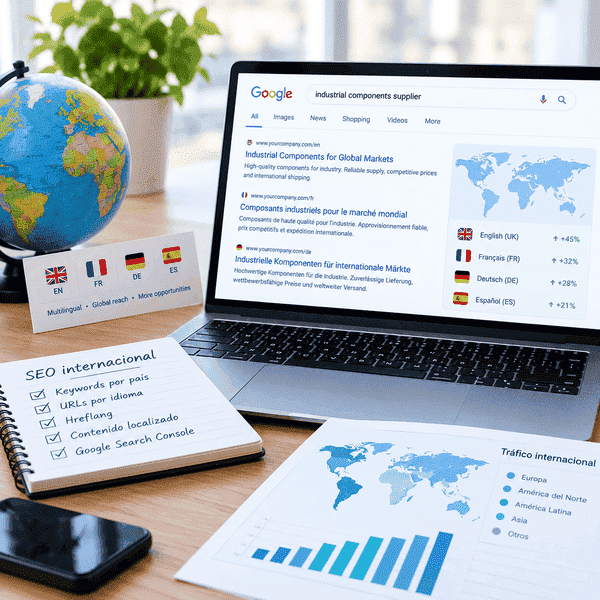
International SEO to Attract International Customers Through Your Website

Step 3: How to Attract International Customers Through Your Website: Turn Visits into Enquiries

Attracting international traffic is only half the job. The other half is getting those visitors to contact you.

  • Short forms in the visitor’s language. Ask only for essential information. A lengthy form can discourage visitors from submitting their details.
  • Clear calls to action. Buttons such as “Request a quote” or “Get in touch today” encourage international visitors to take the first step. They should be clearly visible, not hidden in the website footer.
  • Market-specific landing pages. Pages tailored to each country, with the appropriate language, currency, and messaging, can significantly improve conversion rates.
  • Valuable content before the sale. A downloadable catalogue, a technical data sheet, or an industry report helps build trust and provides an initial point of contact with prospects who have already shown interest.

Step 4: How to Attract International Customers Through Your Website: Generate Leads Consistently

A website that attracts customers is not a project you simply complete: it is a system that needs to be continuously developed and measured.

  • Publish SEO content in each language. A blog or resource section can consistently attract international organic traffic. Providing content in the user’s native language improves their experience, increases the time they spend on your website and, in many cases, boosts conversions.
  • Classify your leads (A, B, C). Not all contacts have the same commercial potential. Prioritise your time according to each prospect’s genuine interest and purchasing power.
  • Integrate your website with your CRM. Recording every contact generated through your website helps prevent missed opportunities and allows you to measure the actual performance of your online activities.
  • Measure results by market. Key performance indicators include international website visits, conversion rates, and meetings generated. Segment your data by language and country to identify which markets generate revenue and which offer investment opportunities.

The 4 Most Common Website Mistakes Made by Companies Looking to Export

  1. Having a website only in English. Without a version in another language, most potential customers will not even understand your offer.
  2. Having a slow website that is not mobile-friendly. Visitors leave before they even discover your product.
  3. Not having a clear contact form. If potential customers cannot find how to contact you, the sale is lost before it even begins.
  4. Failing to measure and analyse traffic. Without analytics, it is impossible to know where your customers come from or which activities are working.

Is It the Right Time to Internationalise Your Website?

Having a multilingual website is not simply about “translating pages”. It means adapting your website so that people in other countries can find you, understand your offer, and trust your company.

It may not be the right time yet if:

  • You do not have the resources to keep content up to date in several languages.
  • You have not defined a clear value proposition for your target country.
  • You will not be able to respond quickly to enquiries in the relevant language.

Grants to Help Finance Your International Website

If your company is based in UK, public funding programmes may cover part of this investment. Internationalising your website does more than help you attract customers: it can also open the door to public funding.

Where to Find the Latest Grants and Funding Opportunities:

  • Government Funding Resources: Explore the UK Government’s business finance and support portal to discover available funding programmes based on your location and industry.
  • Local Business Support Networks: Contact your nearest Growth Hub or Local Enterprise Partnership (LEP) to access personalised advice and information about funding opportunities.
  • Chambers of Commerce: Check your regional Chamber of Commerce for updates on grants, business support initiatives, and networking events.
  • Industry-Specific Organisations: Businesses in sectors such as tourism, hospitality, retail, and the charity sector can benefit from subscribing to industry newsletters to stay informed about relevant grants and financial support schemes.

Website Expenses: Which Costs May Be Eligible for Funding? Funding programmes vary, and not all website-related expenses qualify for financial support. Depending on the scheme, eligible costs may include:

  • Website design and development: Professional web design services and website development.
  • Domain registration: The cost of purchasing or renewing your domain name.
  • Website hosting: Hosting fees, particularly for the first year.
  • E-commerce features: Integrating online shops, payment gateways, and other e-commerce tools.
  • Business email setup: Creating professional email accounts linked to your domain.
  • Essential software and licences: Expenses such as SSL certificates and website-building platform subscriptions.
  • Initial digital marketing: Basic SEO services, pay-per-click (PPC) campaigns, and content creation.
  • Staff training: Training employees to manage, maintain, and update the website independently.

Important: Eligible expenses depend on the specific grant or funding programme. Always check the official guidelines before committing to any costs.


Frequently Asked Questions: How to Attract International Customers Through Your Website

Frequently Asked Questions: How to Attract International Customers Through Your Website

How many languages does my website need to support exporting?

Start with one: the language of your priority market, which is often English. A well-developed and regularly maintained website in one foreign language is better than five outdated, automatically translated versions.

What is hreflang, and why is it important?

Hreflang is an HTML attribute that tells Google which language and, where relevant, which country each version of your page targets. This helps users see the most appropriate version of your website and prevents your different language versions from competing unnecessarily in search results.

Should I use subdirectories or country-specific domains?

For most SMEs, subdirectories (such as /en/ or /fr/) are the best option. They are easier to maintain and help consolidate domain authority under a single domain.


Turn Your Website into Your Best International Sales Representative

Attracting international customers through your website is a process: preparing your website for foreign buyers, increasing its visibility, turning visits into enquiries, and measuring results. Companies that approach this systematically become less dependent on trade fairs and cold calling.

At Barcelona Export, we help SMEs take this step.

Would you like to assess how well your website is performing and identify where to start? Contact us and we will prepare a personalised assessment with an initial action plan tailored to your business.

Catalunya Exporta Roadmap: the free guide to getting started with exporting in a structured way

The Catalunya Exporta roadmap is a free diagnostic service funded by ACCIÓ that assesses a company’s starting point and defines the key elements of its export strategy. It is prepared by an accredited internationalisation support agent and is designed for companies that do not yet sell abroad or have only recently started exporting. Its objective is simple: to ensure that a company’s first step into international markets is guided by a plan rather than intuition.

In this article, we explain what the programme is, what the roadmap assesses, who prepares it and how to get the most out of it.


What is Catalunya Exporta?

Catalunya Exporta is ACCIÓ’s export initiation programme. ACCIÓ is the agency for business competitiveness of the Government of Catalonia. The programme is part of the Responem plan and, according to information published in February 2026, aims to help up to 2,000 companies that have never sold abroad start exporting within three years. The goal is for half of them to become regular exporters before 2030. The programme has a budget of €3 million.

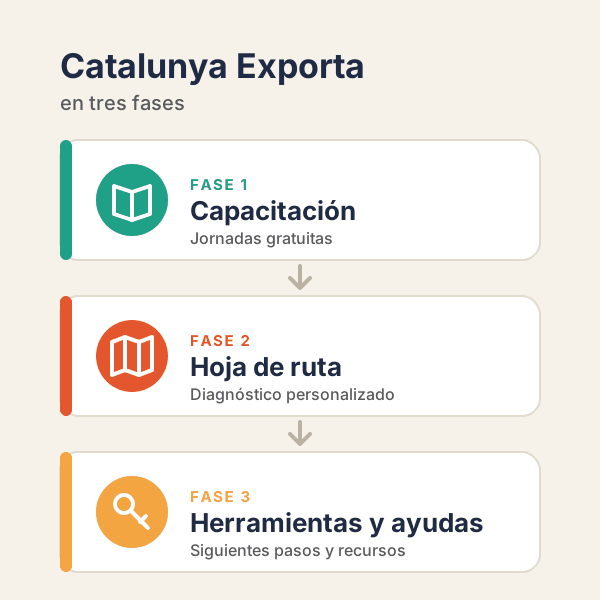
The programme is organised into three phases:

  1. Training sessions. Free sessions covering the fundamentals of international trade, including Incoterms, digitalisation and international sales management.
  2. Catalunya Exporta roadmap. A personalised assessment of the company’s export potential, which we explain below.
  3. Tools and support schemes. Once the assessment has been completed, ACCIÓ helps identify the grants, services and tools best suited to each company’s project.

The three phases of Catalunya Exporta: training, the Catalunya Exporta roadmap, and tools and support schemes.

Who prepares the Catalunya Exporta roadmap?

The Catalunya Exporta roadmap is prepared by an internationalisation support agent accredited by ACCIÓ. These agents include chambers of commerce, business associations and specialist consultancies. Companies can choose the agent that best matches their sector and working methods. If they are unsure which one to select, they can submit a form and ACCIÓ will assign an agent.

The service is free for the company because it is funded by ACCIÓ. The process combines interviews with management, a review of company information and an analysis of its existing channels.


What does a Catalunya Exporta roadmap assess? The 12 sections

The Catalunya Exporta roadmap follows a clearly defined structure. These are the sections it typically includes and what each one is designed to achieve:

  1. Company profile. Basic details, sector and contact person.
  2. Company description. Products or services, customers and current markets. This section often reveals that a company is already selling to foreign customers without leaving its domestic market, for example through tourism.
  3. International experience. Countries already explored, previous contacts, distributors or partners, and certifications required to sell abroad.
  4. Organisational structure. Who could take responsibility for the international project and how much time they could dedicate to it.
  5. Financial capacity. Available resources for travel, product adaptation or promotional investment, and the sources of the company’s revenue.
  6. Communication channels and customer access. Website, social media, newsletter and catalogues. This usually includes a basic website audit covering indexing, page titles, meta descriptions, image alt text, versions in other languages and security.
  7. Preliminary Business Model Canvas. A concise business model outlining the value proposition and the customer segments the company could target abroad.
  8. SWOT analysis. The company’s strengths, weaknesses, opportunities and threats in relation to internationalisation.
  9. Sustainability and gender equality. Environmental and social measures, as well as equality initiatives, which are increasingly valued by international customers and distributors.
  10. Reflection. The company’s objectives and underlying reasons for expanding abroad: diversifying risk, growing, increasing brand recognition or innovating.
  11. Final recommendations. Specific next steps and public-sector resources suited to the company.
  12. Conclusions. An overall assessment of the company’s export potential.

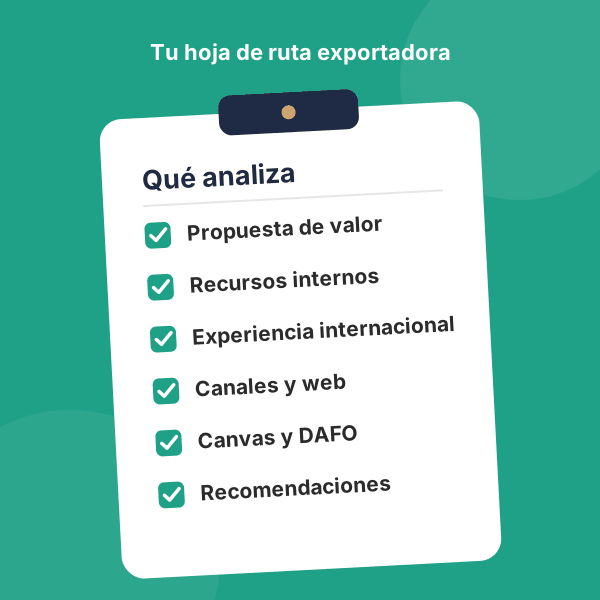
Checklist of what the Catalunya Exporta roadmap assesses: value proposition, resources, channels, SWOT analysis and recommendations.

Why internal reflection comes before market selection

Many companies begin their international journey by asking which country they should target. The Catalunya Exporta roadmap reverses this order, first asking what makes the company’s offering different and what resources it has available.

This reflection helps prevent common mistakes, such as entering a market without a translated website, sufficient stock or anyone on the team with time to dedicate to the project. It also helps turn what already works in the domestic market into a compelling export sales proposition. Once a business model has been validated at home, the challenge is no longer simply to “sell more abroad” but to “replicate abroad what already works at home”.

The Business Model Canvas and SWOT analysis are the two key tools in this phase. The first requires the company to articulate its value proposition in a clear sentence. The second brings potential risks to light, such as dependence on a small number of sales channels, rising raw material and logistics costs, or the risk of copycat products in digital markets.


What recommendations does the Catalunya Exporta roadmap typically include?

The Catalunya Exporta roadmap does not end with a diagnosis: it provides a way forward. Its recommendations often connect companies with the public and private ecosystem supporting exports, which is extensive in Catalonia:

  • ACCIÓ’s Internationalisation Voucher, which helps fund services such as an internationalisation plan, market research for priority countries, or the implementation of an export strategy through active sales prospecting carried out by expert advisers accredited by ACCIÓ.
  • ICEX Next, ICEX’s programme for structuring the international strategy of SMEs starting to export.
  • Chambers of commerce and business associations such as PIMEC, which offer training, trade missions and B2B networking events.
  • Enterprise Europe Network, which helps companies find partners, distributors and commercial agents in Europe.

These support schemes are complemented by practical recommendations, such as improving website visibility in other languages, preparing a B2B sales presentation in English, or identifying the two or three priority markets to target first.


How to get the most out of the Catalunya Exporta roadmap

The quality of the Catalunya Exporta roadmap depends largely on the information the company provides. The following tips can help:

  • Prepare your figures before the interview: revenue by channel, key customers and any previous international contacts.
  • Be realistic about your resources: team availability, budget and production capacity.
  • Involve senior management: exporting is a strategic decision and requires a clearly designated person in charge.
  • Set priorities: it is better to start with one or two carefully selected markets than to target ten at once.
  • Turn the document into an action plan, with deadlines, responsibilities and a budget, and review it again after a few months.

Frequently asked questions about the Catalunya Exporta roadmap

How much does the Catalunya Exporta roadmap cost?

Nothing. The service is free for the company because it is funded by ACCIÓ.

Who can apply?

It is intended for companies that do not yet export or are taking their first steps into international markets and want to establish a stable export activity.

How do you apply?

Through the Catalunya Exporta page on ACCIÓ’s website, selecting Foment del Treball as the organisation.


Take the first step: apply for a completely free Catalunya Exporta roadmap

Exporting is about more than increasing sales. It is a strategic decision that can diversify risk, strengthen your brand and open up new business opportunities. The Catalunya Exporta roadmap offers a free, structured way to get started.

If you are considering taking the next step, Barcelona Export can support you in preparing your roadmap and planning the steps that follow. Contact us.

How to Build a Realistic Export Strategy | Step-by-Step Guide

Many companies embark on exporting without a clear export strategy, without first answering the basic questions: Which products genuinely have potential abroad? Who are our ideal customers in international markets? Which markets should we prioritise, and why? Without this preliminary work, internationalisation becomes a series of disconnected attempts, with no clear direction or meaningful measurement of results.

Building a realistic export strategy requires a structured process divided into three main stages: an internal analysis of the company, an external analysis of the market and competition, and finally, the definition of the strategy and action plan. Below, we explain each stage and the key questions you need to answer.


1. Internal analysis: Where are we starting from?

The first step is to honestly assess the company’s current export strategy, its level of development and its degree of penetration in the markets where it is already present. At this stage, it is useful to consider a clear distinction: is export activity occasional, or is the company genuinely working to build loyalty among international customers?


Analysing products and services for internationalisation

It is not always possible—or advisable—to export the entire product range. The key questions at thi De s stage are:

  • Which products or services have the greatest potential in international markets?
  • Do products need to be adapted for each target market for cultural, climatic, technological or religious reasons?
  • What competitive advantage do our products have internationally? A thorough competitor analysis will be essential here.
  • What are the costs of adapting or certifying products for new markets? It is important to establish whether certification is required and how much it will cost.

Current customers

Before looking for new customers abroad, it is worth understanding the ones we already have:

  • Which sectors do our current customers operate in?
  • How many customers do we have, and how large are they?
  • What are the profiles of the decision-makers involved in purchasing?
  • Which factors do these customers value most?
  • What are their concerns or reservations?
  • Does our current strategy genuinely help us acquire new customers?

Current markets

  • Which markets are currently our priorities?
  • How do we sell in these markets?
  • Is our digital strategy geared towards them?

Value proposition

Every export strategy needs a clear value proposition: why a product or service is attractive to international markets and how it differs from the competition. This means identifying the key benefits for international customers, including functional advantages, economic benefits, emotional or brand-related impact, and regulatory compliance. It also means assessing the company’s ability to adapt to local needs through market-specific customisation, technical support, after-sales service and specialised training for international customers.


Auditing digital and physical channels: essential to developing a sound export strategy

Finally, as part of the internal analysis, the company needs to audit its current action plan:

  • Which channels is the company present on?
  • What specific activities are being carried out?
  • How much is being invested in marketing?
  • How effective are current activities?
  • What human resources are available?
  • Is the current action plan sufficiently customer- and market-oriented?
  • And, specifically, what does a website audit reveal about SEO, mobile responsiveness, traffic and technical errors?

estrategia de exportación1 Estratègia d'exportació1 Export strategy1 Stratégie d'exportation1

2. External analysis: What is happening in the market?

Once the internal assessment for our export strategy is complete, it is time to look outwards at the industry, target markets and competition.

Industry trends

  • How is the industry evolving globally?
  • Have new business models emerged?
  • Are there industry studies related to these changes that we should be aware of?

Market prioritisation

This is probably the most delicate stage of any export strategy, and decisions should be based on objective criteria:

  • What criteria can be used to select priority markets?
  • What is the potential demand for our products or services in each market?
  • What barriers to entry exist—legal, tariff-related, regulatory, logistical or cultural—and how do they affect each market?
  • Which payment methods are most commonly used in each market?
  • Which sales and distribution channels are most effective for reaching customers in each market?

Competitor analysis: key to a sound export strategy

It is impossible to enter a new market without understanding who you will be competing against:

  • Who are the main competitors, both offline and online, in the target markets?
  • Which competitors have the strongest market presence?
  • What strategies do they follow?
  • Which channels are they active on?
  • What are the strengths and weaknesses of their websites?
  • Which keywords are they competing for in search engines?

Target sectors

  • Which sectors have the greatest demand for our products or services?
  • Which sectors are growing fastest internationally?
  • What is the profile of potential customers in each target sector?
  • How can we adapt our offering to better meet the needs of each sector?

SWOT and CAME analysis

All this internal and external analysis should be brought together in a SWOT analysis (strengths, weaknesses, opportunities and threats) and its corresponding CAME analysis (correct weaknesses, address threats, maintain strengths and exploit opportunities). Together, these provide a direct bridge to defining the export strategy.


3. Export strategy and action plan

Once the assessment is complete, it is time to make decisions and take action.

Business model

  • Will new business models be developed for online and offline channels?
  • Which markets will be prioritised in the internationalisation strategy?
  • Which sectors and industries will be prioritised?
  • What will the sales model look like, both online and offline, and is there a risk of channel conflict?
  • If channel conflict arises, how will we address it?

Buyer personas

Precisely defining international buyer personas, using tools such as LinkedIn to identify them, is essential to ensuring that sales and marketing activities are properly targeted.


Defining the export strategy action plan: channels, activities, resources, suppliers and investment

Every export strategy must be translated into a plan of specific actions linked to concrete channels and aligned with the agreed international strategy. This involves:

  • Scheduling activities and assigning teams responsible for each specific task.
  • Identifying suitable suppliers for each activity, along with the estimated investment required.
  • Implementing the activities and scheduling the corresponding campaigns.

estratègia d'exportació 2

Make use of available grants and subsidies

If your company is based in Catalonia, ACCIÓ’s Catalunya Exporta programme offers vouchers worth up to €8,000 per company per year to fund support from an accredited internationalisation adviser in developing an export strategy.

The vouchers are aimed at SMEs with an operational headquarters in Catalonia that generate no more than 25% of their turnover from exports, recorded at least €250,000 in revenue in the previous year, and have a website available in at least one foreign language. Companies have 18 months to implement their export strategy, and vouchers are awarded in chronological order of application, with funding typically running out quickly. This year’s application period opened on 14 May 2026.


A realistic export strategy is not based on intuition or copying what the competition does. It starts with an honest internal assessment, a rigorous external analysis of the market and competitors, and a concrete action plan with clear deadlines and assigned responsibilities. Only when these three elements are aligned does internationalisation stop being an experiment and become a driver of sustainable growth.

If you would like help developing your export strategy, Barcelona Export can provide a personalised analysis and an initial action plan tailored to your company’s specific circumstances.

Export for the first time: Where to start if your SME wants to sell outside the local market?

In this article, we give you an honest guide to the first steps to export for the first time, and explain how you can train yourself—free of charge—to do it with the highest guarantees of success.

You have a good product, satisfied customers in Spain, and a persistent feeling that there is demand abroad. But every time you consider exporting for the first time, the same question holds you back: where do I start?

If you recognise yourself in this situation, you are not alone. It is the starting point for most Catalan SMEs taking their first international steps, and it is also exactly the starting point of the Catalunya Exporta training sessions by ACCIÓ, designed and delivered by Barcelona Export in collaboration with Foment del Treball Nacional.


The most common mistake when exporting for the first time: jumping in without looking

Many SMEs that try to export for the first time make the same mistake: they start at the end. They receive an enquiry from a foreign client, or someone mentions an opportunity in a specific market, and they jump straight into negotiations without any prior preparation. The result is almost always the same: a failed deal, a poorly chosen distributor, or a market that wasn’t suitable for the product.

Successfully exporting for the first time is not a matter of luck, but of preparation. And that preparation begins long before contacting your first international client.


The 5 first steps to export for the first time

1. Assess your product’s export potential

The first step is not choosing a market: it is honestly assessing whether your product is ready to compete abroad. Does it comply with destination market regulations? Is the export price competitive once logistics costs and channel margins are included? Does it require adjustments in packaging, labelling or ingredients?

Many SMEs discover at this stage that adjustments are needed before going abroad. It is far better to identify this now than after signing a contract.

2. Choose the market based on criteria, not intuition

The ideal export market is not the one you’ve heard most about, nor the one someone recommended at a trade fair. It is the one that best combines three factors: real demand for your product, accessibility (logistics, regulation, entry barriers), and manageable competition.

Tools such as the ITC Market Access Map, ACCIÓ market reports, or foreign trade databases allow you to make this decision based on real data. In the training sessions of the Catalunya Exporta programme, we dedicate specific time to teaching how to use these tools in practice.

3. Understand the rules of the game: documentation, tariffs and regulation

Exporting for the first time means becoming familiar with a documentary framework that can seem overwhelming at the beginning: commercial invoice, packing list, certificate of origin, export customs declaration, Incoterms… The good news is that once you understand the logic of the system, it becomes manageable. The bad news is that a documentation error can cost you the deal or lead to customs penalties.

4. Decide how you will enter the market: the distribution channel

Will you sell directly to the end customer? Through a commercial agent? With an exclusive distributor? On a B2B marketplace? This decision—the distribution channel—is one of the most strategic in the export process and has a major impact on results.

Each option has advantages and drawbacks in terms of control, margin, speed of market entry and risk. The right choice depends on the product, the market and the company’s resources. There is no universal answer.

5. Set export pricing correctly

Export pricing is not your domestic selling price plus a percentage. It has its own logic, including production costs, international logistics costs (insurance, transport, customs), distributor or agent margins, local taxes in the destination market, and your desired market positioning.

Incorrect pricing is one of the most costly mistakes an SME can make when trying to export for the first time. In too many cases, it results in selling abroad with lower margins than in the domestic market, making the export activity unsustainable in the long term.


Exportar por primera vez 1 Exportar per primera vegada 1 Export for the first time 1 Exporter pour la première fois 1

Catalunya Exporta training sessions: free training to export for the first time

All these topics—and many more—are exactly what is covered in the training sessions of the Catalunya Exporta programme designed and delivered by Barcelona Export in collaboration with Foment del Treball Nacional.

These sessions are designed to share basic but solid knowledge on the most relevant export topics and provide companies entering internationalisation with practical tools to export successfully. Key features:

  • 100% virtual format: attend from anywhere without travelling
  • Maximum duration of 60 minutes: focused, practical content
  • Fortnightly schedule: one session every 15 days over the next 3 years
  • Varied and progressive topics: each session covers a key export aspect
  • Completely free for SMEs participating in the Catalunya Exporta programme

The session calendar covers a wide range of topics: from the first steps to export for the first time to negotiating with international distributors, export financing, product adaptation, international payment methods, and customs management. A complete training journey delivered in short fortnightly modules, fully compatible with any company’s daily operations.


The personalised diagnosis: your free roadmap

Beyond the group sessions, the programme includes a free personalised export diagnosis for each participating company. The result is a concrete roadmap: to export for the first time, it is essential to know which markets to explore, which entry channel is most appropriate, what product adaptations are needed, and what steps to take over the next 90 days.

It is not a generic report: it is a tailor-made analysis of your company, product and resources, prepared by the team at Barcelona Export.


Exportar por primera vez 2 Exportar per primera vegada 2 Export for the first time 2 Exporter pour la première fois 2

The first step is the most important

Exporting for the first time may seem complex, but with proper preparation and the right support it is entirely achievable for an SME with a competitive product and a willingness to learn. The Catalunya Exporta training sessions are precisely that structured first step many companies need to move from intention to action.

Check the session calendar and register directly on the Foment del Treball website:

👉 View sessions and join the Catalunya Exporta programme

Do you want the personalised diagnosis or have questions about whether your company is ready to export? Contact Barcelona Export and we will reply within 48 hours.

Catalunya Exporta programme: the ACCIÓ programme helping Catalan SMEs start exporting

Discover the Catalunya Exporta programme by ACCIÓ: grants of up to €10,500, training and expert guidance to help your Catalan SME start exporting in 2026.

If you run an SME in Catalonia and have been thinking about selling outside Spain, here’s some news worth your attention: the Catalunya Exporta programme by ACCIÓ, the Agència per la Competitivitat de l’Empresa, is the most powerful public initiative currently available to help Catalan businesses make the leap into international markets. At Barcelona Export we explain everything you need to know to make the most of this opportunity.


¿What is the Catalunya Exporta programme?

The Catalunya Exporta programme is a public-private initiative driven by the Government of the Generalitat de Catalunya through ACCIÓ. It runs for three years (2026–2028), has a budget of over €3 million and an ambitious goal: to help 2,000 Catalan companies start exporting for the first time or consolidate their presence in foreign markets. It forms part of the Catalan Economy Internationalisation Strategy 2026–2030, which aims to reach 19,000 regular exporting companies across Catalonia.

The Catalunya Exporta programme does not work alone. It is developed jointly by ACCIÓ and a network of leading business organisations: the Consell General de Cambres de Catalunya, Foment del Treball Nacional, PIMEC, Secartys, TecnoCampus, Amec, the Fundació Cecot Innovació, Texfor, FITEX, the Centre Metal·lúrgic and the AEGP. A coalition that guarantees broad sectoral coverage and genuine on-the-ground support.


What does the Catalunya Exporta programme offer your business?

The Catalunya Exporta programme is not just training: it is a complete roadmap that accompanies the company from the initial diagnosis through to the execution of the export plan. The main pillars are:

1. Specialist training sessions Workshops and sessions on international training, export financing, building an export department, how to find international distributors, adapting your product to foreign markets and much more. Sessions are scheduled every two weeks, allowing businesses to keep pace without disrupting day-to-day operations.

2. Personalised export diagnostic Each company receives an analysis of its real starting point: the product’s export potential, the most suitable markets, the optimal entry channel and the resources required. The outcome is an actionable initial plan with specific tasks, responsibilities and deadlines.

3. Access to ACCIÓ tools and resources Participating companies gain access to ACCIÓ’s full service portfolio: market intelligence and opportunities, support for tariff barriers, resolution of international trade obstacles and, above all, the internationalisation vouchers described below.


Catalunya Export Programme

The ACCIÓ Vouchers: direct funding to start exporting

Within the Catalunya Exporta programme ecosystem, the ACCIÓ Vouchers are the most direct funding instrument available to Catalan SMEs. The 2026 call — now open — offers two options:

  • Vouchers to start exporting: up to €10,500 grant (100% of the budget). Aimed at companies that do not yet export or whose foreign sales do not exceed 25% of turnover.
  • Vouchers for internationalisation plans: up to €8,000 grant (100% of the budget). For companies with some export experience that want to structure and scale their strategy.

In both cases, the voucher is redeemed with an ACCIÓ-accredited Internationalisation advisor — such as BarcelonaExport — who designs and executes the internationalisation project alongside the company.

Basic requirements to access the vouchers:

  • Be an SME with operational headquarters in Catalonia
  • Have invoiced a minimum of €250,000 in the previous financial year
  • Have a website in at least one foreign language
  • Be up to date with tax and Social Security obligations

One important point: vouchers are awarded in strict chronological order of application and tend to run out within a few weeks of the call opening. In 2026 the call opened on 14 May. If you are reading this now, don’t leave it until tomorrow.


Why trust an accredited adviser like Isabel Garcia at BarcelonaExport?

Working with an ACCIÓ-accredited Internationalisation adviser makes a real difference. Not only because the voucher itself requires it, but because the export process — finding distributors, negotiating contracts, adapting to local regulations — has a steep learning curve that can prove very costly without expert guidance.

At BarcelonaExport we have spent years supporting Catalan SMEs in their internationalisation journey: from market selection through to signing the first contract with an international distributor. Within the Catalunya Exporta programme, we can help you apply for the vouchers, design your export plan and execute every step with a proven methodology.


The time to export is now

Catalonia is Spain’s leading exporting region, with over €74 billion in exports and a presence in more than 180 markets. Yet 42% of those exports are concentrated in large companies. The Catalunya Exporta programme exists precisely so that SMEs — the true engine of the Catalan economy — can also benefit from international growth.

If your company has a strong product, productive capacity and a vision for the future, the Catalunya Exporta programme by ACCIÓ could be the catalyst you have been waiting for. The question is not whether you should export, but when you start.

Want to know whether your company can access the Catalunya Exporta programme and the 2026 ACCIÓ Vouchers? Get in touch and we will provide a free diagnostic within 48 hours.