
The ICO Export Growth Line Is Back: Public Financing for SMEs Selling Abroad

The ICO Export Growth Line is a direct loan from the Instituto de Crédito Oficial (ICO) for Spanish SMEs with international activity, featuring a non-repayable component of up to 30% (maximum €200,000), an interest rate of Euribor + 0.75%, and a repayment period of up to 10 years. Its first call closed on 1 July 2026, and many companies missed out because they did not have enough time to prepare their applications.
If your company exports or imports and is feeling the impact of tariffs, the ICO Export Growth Line is probably one of the most interesting public financing opportunities of the year. In this article, we explain what the scheme is, who can apply, what it covers and how to prepare so you are ready in time for the next call.
What is the ICO Export Growth Line and why was it created?
The ICO Export Growth Line is a €750 million financing line launched on 9 February 2026 by the Spanish Ministry of Economy, Trade and Enterprise, through the Secretary of State for Trade and the ICO (official ICO announcement).
Its objective is to finance investment and modernisation projects carried out by SMEs affected by changes in the global tariff environment.
The key feature is its support component: €181 million from the Next Generation EU funds, which the ICO applies in two ways. One is a non-repayable component within the loan; the other is a partial interest-rate subsidy (La Moncloa).
Unlike ICO intermediary financing schemes, there is no need to apply through a bank: the application is submitted directly to the ICO, entirely online. This is an important difference for SMEs whose banks are reluctant to finance their exposure to markets affected by trade tensions.
ICO Export Growth Line loan conditions
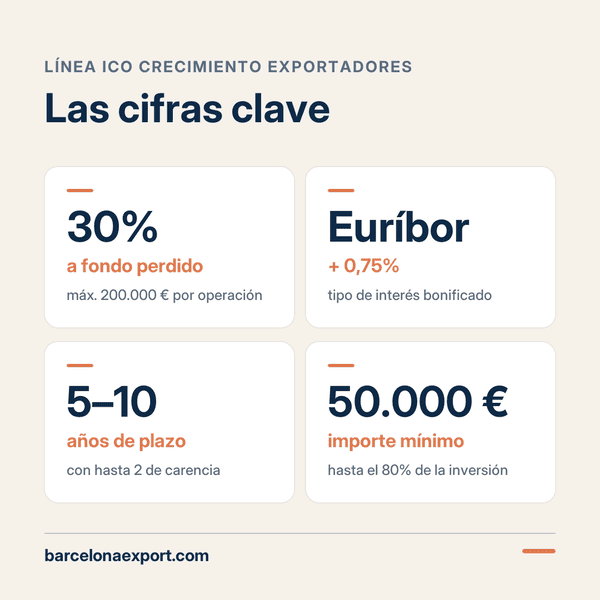
The following were the conditions of the 2026 call, according to the summary of the General Conditions Document published by Impulso and FEDA:
| Item | Condition |
|---|---|
| Minimum amount | €50,000 |
| Maximum amount | Up to 80% of the eligible investment |
| Interest rate | 1-year Euribor + 0.75% (100 basis-point subsidy) |
| Term | 5 to 10 years, with up to 2 years’ grace period |
| Non-repayable component | Up to 30% of the loan, with a maximum of €200,000 |
| Arrangement fee | 0.5% of the contracted amount |
| Working capital | Up to 30% of the project, always linked to the investment |
| Allocation | On a first-come, first-served basis, until funds are exhausted |
The non-repayable component is not paid out in cash: it is used to repay the final instalments of the loan if the relevant conditions are met.
The first-come, first-served allocation system therefore has a very practical implication: companies that have their application ready from day one have an advantage.
Requirements: who can apply for the ICO Export Growth Line?
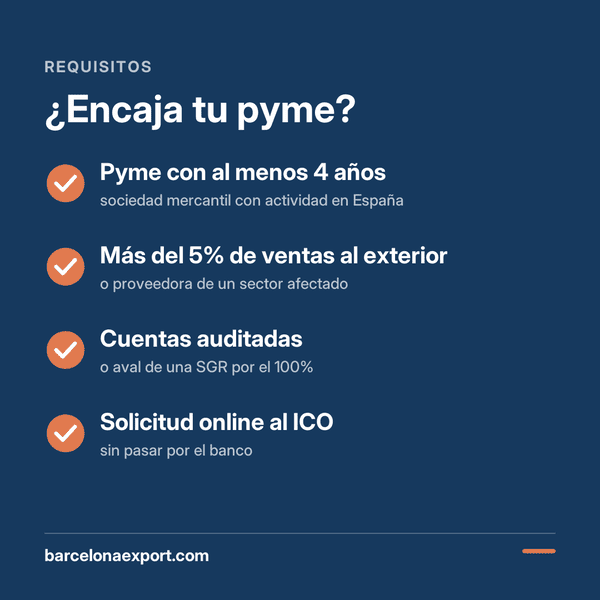
The scheme is open to commercial companies that qualify as SMEs, have their registered office or business activity in Spain and have been operating for at least four years (ICO Online).
In addition, applicants must fall into one of the following two categories:
- Directly affected: exporting or importing SMEs whose international activity represents more than 5% of their turnover.
- Indirectly affected: relevant suppliers to Spanish companies in affected sectors, or SMEs integrated into global value chains (FER).
There is one requirement that excludes many companies: the accounts for the last two financial years must have been audited, either mandatorily or voluntarily.
If they have not been audited, this requirement can be offset by a guarantee: from an SGR covering 100% of the loan, a public guarantee covering at least 50%, or a bank guarantee covering at least 75%.
What expenses and investments does The ICO Export Growth Line finance?
The financing line prioritises investment in intangible assets, but covers a broad range of eligible expenditure:
- Tangible assets: industrial premises, facilities, machinery, ICT equipment, industrial vehicles and renewable energy installations of up to 30 MWp.
- Intangible assets: R&D, patents and designs, software, trademark registration, training and market research for new markets.
- Business acquisitions or equity interests: to increase production capacity, secure supplies or facilitate business succession.
- Working capital: up to 30% of the project.
- Consulting and credit-rating services required to prepare the application, up to 100%.
For exporters, one of the most interesting aspects is what the non-repayable component covers. It includes 50% of the expenditure on international trade fairs and 50% of ICEX internationalisation services.
It also covers 10% of tangible investment by SMEs and 20% by microenterprises.
How to apply for the ICO Export Growth Line: step by step
- Check your eligibility. Calculate the percentage of your turnover generated internationally during the last financial year and gather the customs declarations (DUAs) or invoices that provide evidence.
- Review your financial statements. If they have not been audited, arrange a voluntary audit or start negotiating the required guarantee with an SGR (in Catalonia, for example, Avalis de Catalunya).
- Define your project. Describe the investment, target markets and how the project will reduce your exposure to tariffs.
- Do not start the investment too early. The ICO may require expenditure to be incurred after the application has been submitted in order to preserve the incentive effect of the financing.
- Submit the application through ICO Online using a digital certificate.
- Provide evidence of project implementation so that the non-repayable component can be applied.
Since funding is awarded on a first-come, first-served basis, it is advisable to have steps 1 to 3 completed before the application window opens.
An opportunity for exporting SMEs in Barcelona and Catalonia
Catalonia accounts for a significant share of Spain’s exports and has a strong industrial SME base in sectors such as chemicals, food, textiles, machinery and automotive.
Many of these companies sell to the United States or form part of the supply chains of major European groups — precisely the type of businesses this financing line aims to support.
For an SME based in Barcelona, Vallès or Baix Llobregat, the scheme is particularly relevant in three situations:
- Diversifying markets when a key customer or country becomes more expensive due to tariffs.
- Financing international trade fairs, with 50% of the expenditure covered by the non-repayable component.
- Modernising production facilities to remain competitive on price against new competitors.
If you also use programmes from ACCIÓ or the Barcelona Chamber of Commerce, check the total amount of public aid received. The ICO Export Growth Lineline is subject to the de minimis aid regime, meaning that all relevant aid received counts towards the applicable ceiling.
Frequently asked questions about the ICO Export Growth Line
How much non-repayable funding can I receive?
Up to 30% of the loan, with a maximum of €200,000 per transaction. It is applied to repay the final instalments of the loan.
Do I need to apply through my bank?
No. This is direct financing from the ICO and the application is submitted online. A bank is only involved if it provides a guarantee or co-finances the transaction.
What percentage of exports do I need?
More than 5% of the previous year’s turnover if the company is directly affected. Suppliers in affected sectors may qualify through the indirect route.
Can a self-employed person or a start-up apply?
No. The applicant must be a commercial company, qualify as an SME and have been operating for at least four years.
Can I finance my participation in an international trade fair?
Yes. The non-repayable component covers 50% of eligible expenditure on trade fairs.
How long can I apply for the financing?
The first call closed on 1 July 2026. Check the ICO website for the opening date of the next call: funds are allocated on a first-come, first-served basis.
Conclusion: prepare before the funds run out
The ICO Export Growth Line combines three advantages that are difficult to find together: a low interest rate, a long repayment period and a non-repayable component.
For an exporting SME affected by tariffs, it can help finance market diversification, international trade fairs and modernisation projects that might otherwise be postponed.
The experience of the first call provides a clear lesson: the companies that are ready to apply are the ones that have their financial statements, guarantee and project prepared in advance.
At Barcelona Export, we support Catalan SMEs with their internationalisation strategies, from market selection to the preparation of financeable projects. Contact us and we will assess whether your company could qualify for this financing line.