
Export Documents: A Guide for SMEs

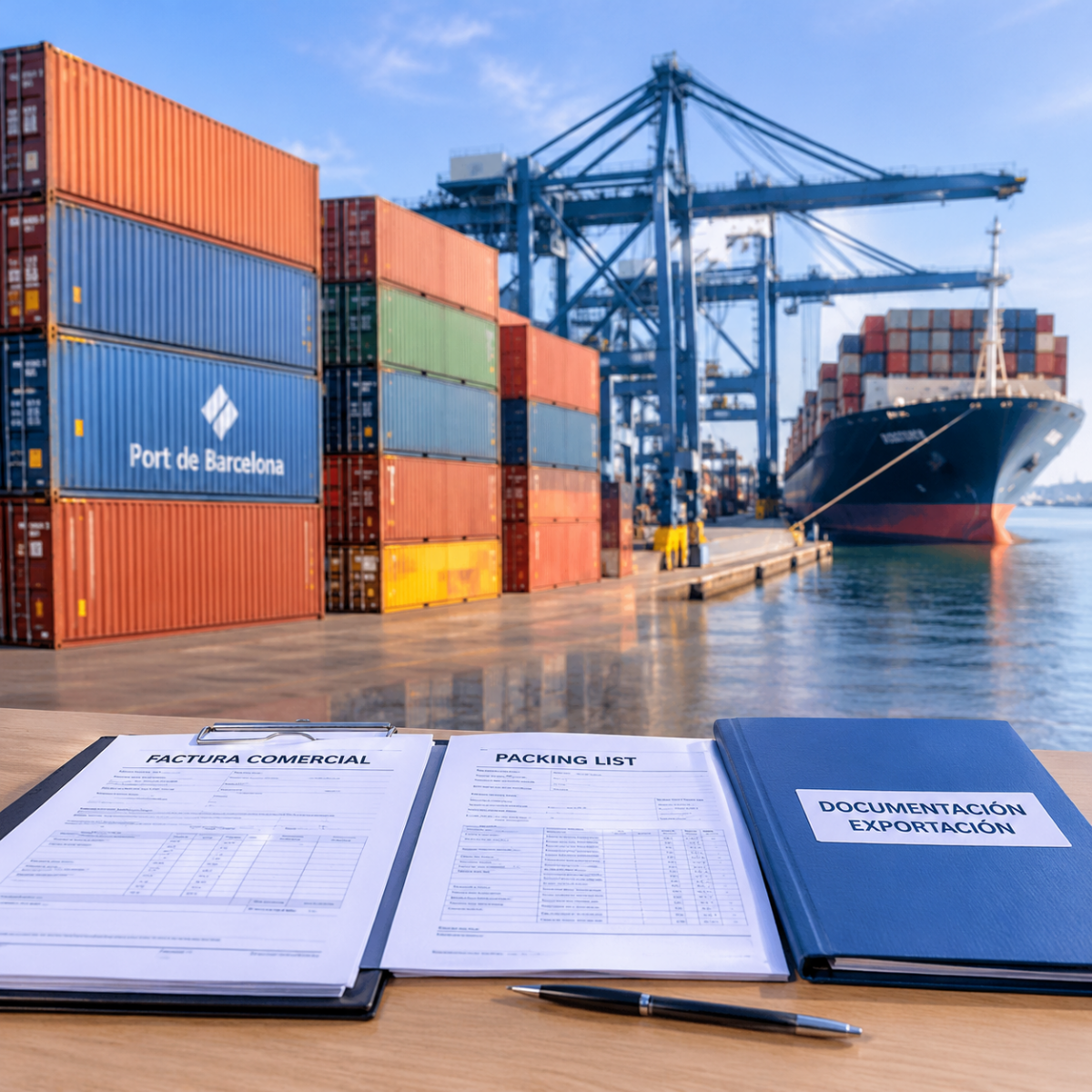
In international trade, there is one rule that never fails: if the documents do not match, the goods are stopped. An incorrect weight, a wrongly entered tariff code or a certificate that arrives late can result in a container being held up at the port or payment being blocked for weeks.
This guide summarises the export documents required by any SME taking its first steps towards internationalisation. It also reviews the most common mistakes and how to avoid them. It is based on the session we delivered as part of ACCIÓ’s Catalunya Exporta programme, together with Foment del Treball.
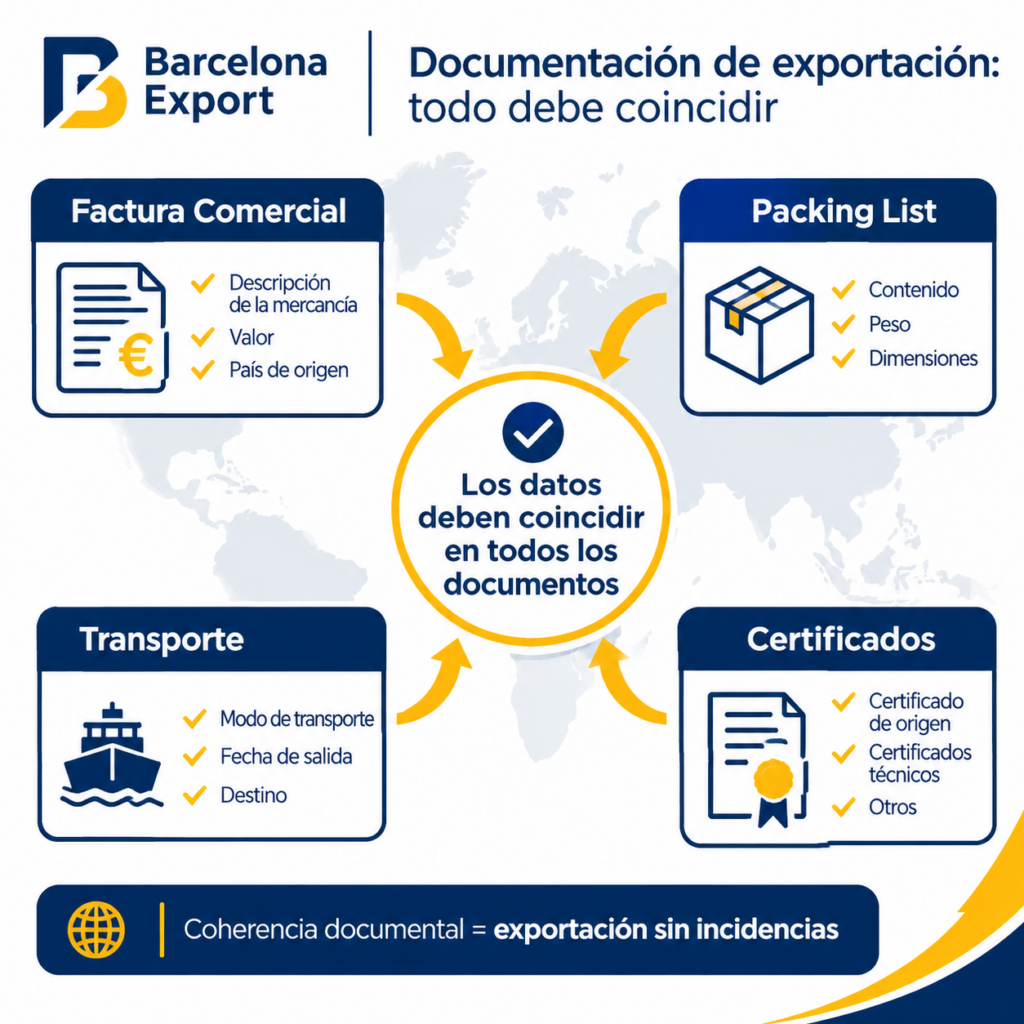
The four main groups of export documents
Every export transaction relies on four groups of documents:
- The commercial invoice
- The packing list
- Transport documents
- Certificates: certificates of origin, health certificates and certificates of conformity
Let’s take a closer look at each one.
1. Export documents: the commercial invoice
This is the sales document and the basis used by the customs authorities in the destination country to calculate duties and taxes. That is why it must be complete and accurate. It should include:
- Seller’s and buyer’s details, including their tax identification numbers and EORI numbers
- Description and HS code of each product
- Quantity, unit price, total amount and currency
- Incoterm, country of origin of the goods and payment terms
The EORI number. This is the identification number assigned by customs authorities to economic operators within the European Union. It is mandatory for all customs procedures. In Spain, it consists of the prefix ES followed by the company’s tax identification number (NIF). If you do not have one yet, you can apply through the Spanish Tax Agency’s electronic office, under “EORI Procedures” (Gestiones EORI), selecting “Register for a Spanish EORI number” (Alta de EORI español).
The correct HS code. The first six digits of the HS code are the same worldwide. In the EU, the Combined Nomenclature adds two more digits, while the TARIC code contains ten digits, which determine the applicable duties and trade measures. An incorrect code can result in higher customs duties, penalties or goods being held up. To find the correct code, consult Access2Markets and the European Commission’s TARIC database.
VAT. Sales to countries outside the EU are exempt from VAT. Indicate this on the invoice and keep the export customs declaration (DUA) as proof.
The pro forma invoice. This is not the final invoice. It is used to request advance payment, open a documentary credit or apply for import licences in the destination country.
2. Export documents: the packing list
This is a detailed list of the contents of each package. It is used by the carrier, customs authorities and the customer to check the shipment. It should include:
- Number and type of packages
- Contents and references of each package
- Net weight, gross weight and dimensions
- Marks, numbering and invoice number
The key here is to make sure everything matches. Quantities and weights must be consistent across the invoice, packing list and transport document. Any discrepancy may trigger a physical inspection. In addition, each package must be marked with its number (1/4, 2/4, etc.), the consignee and the destination port, exactly as stated in the packing list.
3. Export documents: transport documents
Each mode of transport has its own document:
- Sea freight: Bill of Lading (B/L)
- Air freight: Air Waybill (AWB)
- Road transport: CMR consignment note
- Rail transport: CIM consignment note
The Bill of Lading is the most complex document because it serves three purposes at once: it is a receipt for the goods, a contract of carriage and a document of title. Whoever holds the original can claim the goods at the port. If the carrier records damage or defective packaging, the B/L is no longer considered “clean”, and the bank may reject it under a documentary credit.
For example, a company ships olive oil to New York in a 20-foot container. The sale is CIF New York, so the B/L will be issued “to order”, marked “clean on board” and “freight prepaid”, since the seller pays the freight.
The AWB and CMR are not documents of title. They function as international delivery notes: the goods are delivered to the consignee named in them. A signed CMR is also proof of delivery. For example, if a manufacturer in Girona sends furniture to Lyon by truck, the CMR signed by the customer upon unloading provides evidence of the intra-EU sale for VAT purposes.
The export customs declaration (DUA). When goods leave the EU, an export declaration must be lodged with customs. This is normally handled by the freight forwarder. The DUA identifies the exporter, importer and goods, including their value, TARIC code and destination. It confirms that the goods have left the EU and provides tax evidence of the export, for example, to justify VAT exemption.
4. Export documents: certificates
The four most common types are certificates of non-preferential origin, preferential origin proofs (EUR.1), health and phytosanitary certificates, and certificates of conformity and inspection.
Non-preferential certificate of origin. This certifies where the goods were manufactured or obtained, but does not in itself entitle the importer to any reduction in customs duties. It is issued by Chambers of Commerce and is required by certain countries and under many documentary credits. Pay attention to the wording: if the documentary credit requires a certificate of origin issued by Chamber of Commerce, a certificate issued by another organisation will be rejected.
Proof of preferential origin. This certifies that the goods comply with the rules of origin set out in an EU trade agreement, allowing the importer to benefit from reduced or zero customs duties. Depending on the agreement, this may take the form of an EUR.1 certificate, a statement of origin on the invoice or another document. For example, a company selling biscuits to Morocco may provide an EUR.1 certificate so that the buyer benefits from reduced or zero customs duties. Without it, the buyer has to pay the standard tariff, making the product less competitive.
Health certificates. These are generally required for food products and goods of animal or plant origin. They are issued by the competent authority and may take several weeks to obtain. Before selling, check Access2Markets to find out which certificates are required by the destination country for your HS code.
Legalisation. Some countries, particularly in the Gulf region and Latin America, require documents to be legalised or apostilled. Make sure you factor this into your planning.
The four most common mistakes to avoid when preparing export documents
- Inconsistent information. Different quantities, weights or descriptions across the invoice, packing list and B/L can hold up the goods or delay payment.
- Vague descriptions. Terms such as “spare parts” or “samples” are not valid descriptions. Customs authorities need to know exactly what the product is and its HS code.
- Failing to read the documentary credit carefully. Banks check documents word for word. Even a typo can delay or block payment.
- Applying for certificates too late. Health certificates, legalisations and EUR.1 certificates can take days or weeks to obtain. Request them before the goods are loaded.
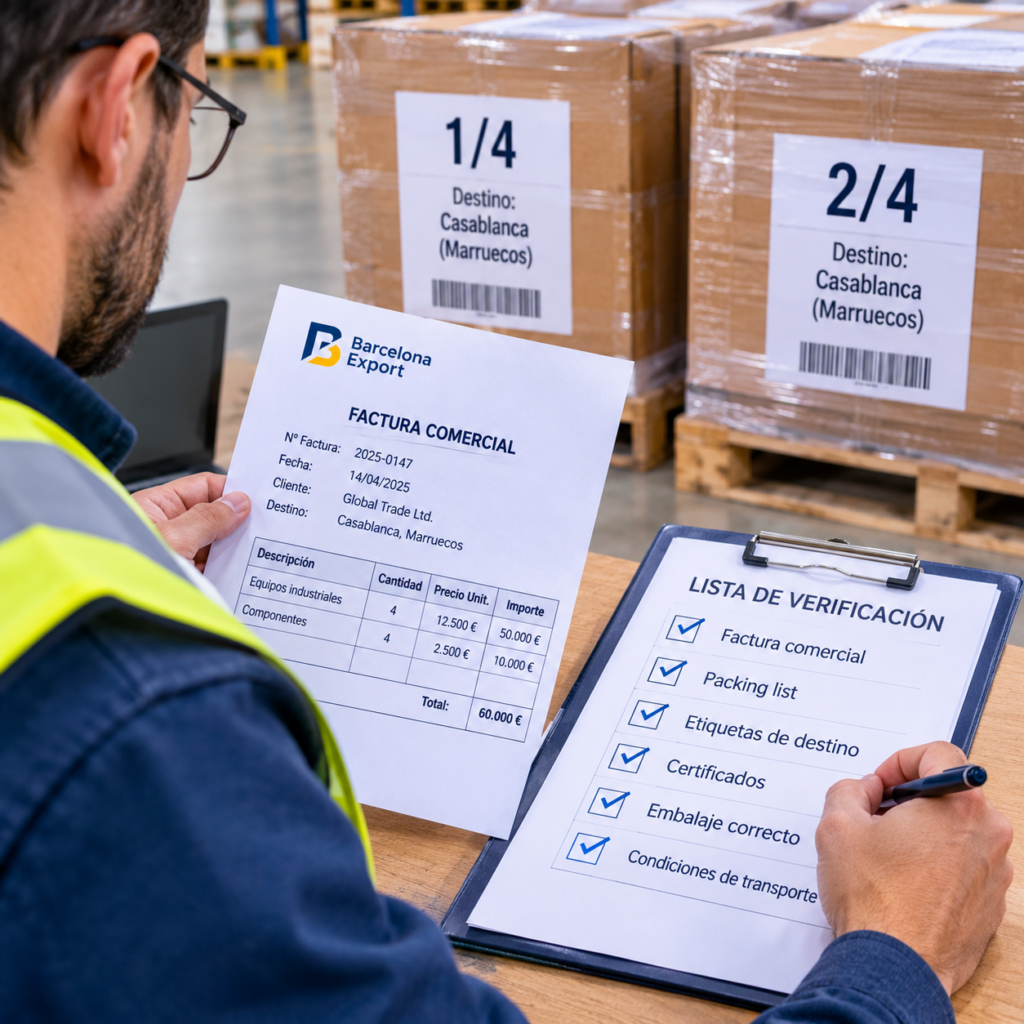
Checklist before submitting your export documents
- HS code and product description checked
- Consistent information across all documents
- Same Incoterm in the quotation and invoice
- Certificates requested and valid
Support programmes to help you start exporting
If your company is taking its first steps into exporting, you do not have to do it alone. ACCIÓ’s Catalunya Exporta programme supports Catalan companies, particularly SMEs, during the initial stages of internationalisation. The Government of Catalonia has mobilised €3 million with the aim of helping 2,000 companies start exporting over the next three years.
There are also specific support schemes available:
- ACCIÓ vouchers for companies starting to export, worth up to €10,500 per company, and vouchers for internationalisation plans, worth up to €8,000. These grants help companies hire an international trade consultant accredited by ACCIÓ. They are aimed at SMEs with an operating base in Catalonia that export less than 25% of their turnover, recorded revenue of at least €250,000 in the previous year and have a website in at least one foreign language. Applications are assessed in order of submission and funding is usually exhausted quickly. The next call for applications is expected around May 2027.
- International Promotion Grant, ranging from €15,000 to €30,000 per company and covering up to 50% of eligible expenditure. It funds websites and e-commerce, digital marketing in international markets, online marketplaces, trade fairs outside Catalonia, and certifications or product approvals. Applicants must have a minimum turnover of €500,000, a website in a foreign language and a current international promotion plan.
Always check the terms and conditions of each call for applications, as funding amounts and eligibility requirements may change.
Need help with your first export?
At Barcelona Export, we guide you step by step so that you can prepare your export documents without errors, delays or payment problems. Request your free personalised assessment and we will suggest an initial action plan tailored to your business.