
How to Attract International Customers Through Your Website: A Practical Guide for SMEs

Many SMEs have a good product, the capacity to increase production, and a strong desire to export. However, they are still looking for customers abroad as they did twenty years ago: trade fairs, cold calls, and purchased databases. Meanwhile, their potential buyers in France, Germany, or Spain are searching on Google for exactly what these companies manufacture… and finding their competitors instead.
To attract international customers through your website, you need a well-optimised online presence that can generate more business opportunities than months of cold prospecting. In this article, we’ll guide you through four practical steps to turn your website into an effective international sales tool, highlight common mistakes to avoid, and explore public funding programmes that may help cover part of the investment.
Why your website is your first international sales representative
Before asking you for a meeting, a foreign buyer visits your website. Within seconds, they decide whether they understand what you offer, whether they trust your company, and whether it is easy to contact you. If the answer is no, you may never even know they were there.
That is why your website is not simply a digital brochure: it is the first filter in your export strategy. You need to understand how to attract international customers through your website. It works 24 hours a day, across all time zones, without the need for a plane ticket.
To genuinely attract customers, your website must fulfil four functions: be tailored to foreign customers, be visible, turn visits into enquiries, and generate business opportunities consistently.
Step 1: How to attract international customers through your website: optimise it for foreign markets
- Create a genuinely multilingual website. Your website needs to speak your customers’ language. Offering at least one foreign-language version immediately builds trust and is also a requirement for accessing several internationalisation grants. But translation alone is not enough: adapt your messaging to the culture of your target market, using examples, units of measurement, regulations, and references that local buyers understand.
- Focus on responsive design and loading speed. A website that works well on mobile phones, tablets, and computers improves the buyer experience and increases conversion rates. Many B2B buyers carry out their initial research on their phones between meetings.
- Build trust. Trust seals, an SSL certificate, and internationally recognised payment methods reduce friction, especially if you sell online.
- Show international testimonials. Featuring customers from other countries, with their logos or short success stories, strengthens your credibility with new international prospects. A German buyer will feel more confident seeing that another German company already works with you.
Step 2: How to attract international customers through your website: increase your visibility in foreign markets
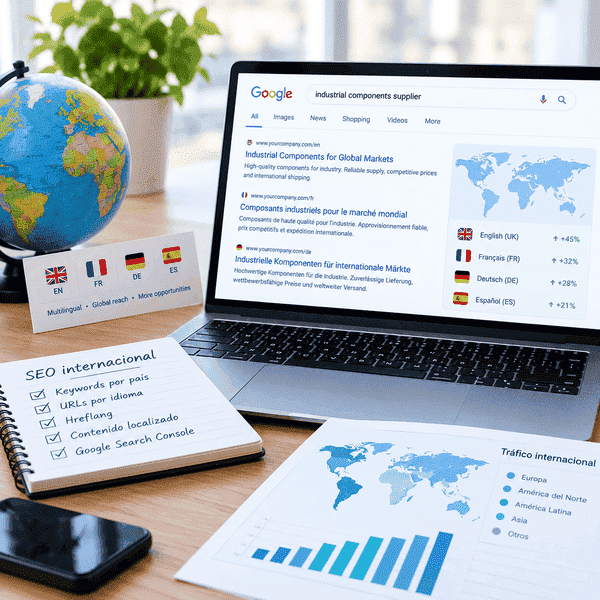
Having a website in Spanish or French is pointless if nobody can find it. This is where international SEO comes in.
Conduct keyword research in your target market’s language. Your customers do not search using literal translations of your keywords. Understanding how people search in their own language and country can make the difference between being found and remaining invisible. Analyse your competitors in that market, too: which keywords they rank for and what content they publish.
Choose the right URL structure. This is one of the most important technical decisions for a multilingual website.
| Structure | Example | When to use it |
|---|---|---|
| Subdirectories | yourdomain.com/en/ | The recommended option for SMEs: easy to maintain, consolidates domain authority, and simplifies analytics. |
| Subdomains | en.yourdomain.com | Only if your technical infrastructure requires it. They can split authority and require more maintenance. |
| Country-specific domains (ccTLDs) | yourdomain.fr | Only if you operate as a local brand in each country, with your own team and billing arrangements. This is the most expensive option to scale. |
Implement hreflang tags. These signals tell Google which version of your website to show to each user. If you target different languages, use codes such as es, en, or fr. If you target specific countries, use es-ES, es-MX, en-GB, or en-US.
Do not overlook the details that make a difference:
- Translate your URL slugs so that each URL is understandable in the relevant language.
- Adapt page titles and meta descriptions to the way each audience searches.
- Submit a sitemap for each language through Google Search Console.
- Link each page to other pages in the same language and avoid mixing languages in your navigation.
- Add a clearly visible language selector in the website header, using language names or codes (“ES”, “EN”) rather than flags.
- Maintain the same page structure across all languages, while localising examples, requirements, and frequently asked questions for each market.
Expand your reach beyond Google. Listing your company on international marketplaces and industry directories can significantly increase your visibility. Meanwhile, country-targeted Google Ads campaigns allow you to reach buyers who are already searching for your products.
Step 3: How to Attract International Customers Through Your Website: Turn Visits into Enquiries
Attracting international traffic is only half the job. The other half is getting those visitors to contact you.
- Short forms in the visitor’s language. Ask only for essential information. A lengthy form can discourage visitors from submitting their details.
- Clear calls to action. Buttons such as “Request a quote” or “Get in touch today” encourage international visitors to take the first step. They should be clearly visible, not hidden in the website footer.
- Market-specific landing pages. Pages tailored to each country, with the appropriate language, currency, and messaging, can significantly improve conversion rates.
- Valuable content before the sale. A downloadable catalogue, a technical data sheet, or an industry report helps build trust and provides an initial point of contact with prospects who have already shown interest.
Step 4: How to Attract International Customers Through Your Website: Generate Leads Consistently
A website that attracts customers is not a project you simply complete: it is a system that needs to be continuously developed and measured.
- Publish SEO content in each language. A blog or resource section can consistently attract international organic traffic. Providing content in the user’s native language improves their experience, increases the time they spend on your website and, in many cases, boosts conversions.
- Classify your leads (A, B, C). Not all contacts have the same commercial potential. Prioritise your time according to each prospect’s genuine interest and purchasing power.
- Integrate your website with your CRM. Recording every contact generated through your website helps prevent missed opportunities and allows you to measure the actual performance of your online activities.
- Measure results by market. Key performance indicators include international website visits, conversion rates, and meetings generated. Segment your data by language and country to identify which markets generate revenue and which offer investment opportunities.
The 4 Most Common Website Mistakes Made by Companies Looking to Export
- Having a website only in English. Without a version in another language, most potential customers will not even understand your offer.
- Having a slow website that is not mobile-friendly. Visitors leave before they even discover your product.
- Not having a clear contact form. If potential customers cannot find how to contact you, the sale is lost before it even begins.
- Failing to measure and analyse traffic. Without analytics, it is impossible to know where your customers come from or which activities are working.
Is It the Right Time to Internationalise Your Website?
Having a multilingual website is not simply about “translating pages”. It means adapting your website so that people in other countries can find you, understand your offer, and trust your company.
It may not be the right time yet if:
- You do not have the resources to keep content up to date in several languages.
- You have not defined a clear value proposition for your target country.
- You will not be able to respond quickly to enquiries in the relevant language.
Grants to Help Finance Your International Website
If your company is based in UK, public funding programmes may cover part of this investment. Internationalising your website does more than help you attract customers: it can also open the door to public funding.
Where to Find the Latest Grants and Funding Opportunities:
- Government Funding Resources: Explore the UK Government’s business finance and support portal to discover available funding programmes based on your location and industry.
- Local Business Support Networks: Contact your nearest Growth Hub or Local Enterprise Partnership (LEP) to access personalised advice and information about funding opportunities.
- Chambers of Commerce: Check your regional Chamber of Commerce for updates on grants, business support initiatives, and networking events.
- Industry-Specific Organisations: Businesses in sectors such as tourism, hospitality, retail, and the charity sector can benefit from subscribing to industry newsletters to stay informed about relevant grants and financial support schemes.
Website Expenses: Which Costs May Be Eligible for Funding? Funding programmes vary, and not all website-related expenses qualify for financial support. Depending on the scheme, eligible costs may include:
- Website design and development: Professional web design services and website development.
- Domain registration: The cost of purchasing or renewing your domain name.
- Website hosting: Hosting fees, particularly for the first year.
- E-commerce features: Integrating online shops, payment gateways, and other e-commerce tools.
- Business email setup: Creating professional email accounts linked to your domain.
- Essential software and licences: Expenses such as SSL certificates and website-building platform subscriptions.
- Initial digital marketing: Basic SEO services, pay-per-click (PPC) campaigns, and content creation.
- Staff training: Training employees to manage, maintain, and update the website independently.
Important: Eligible expenses depend on the specific grant or funding programme. Always check the official guidelines before committing to any costs.

Frequently Asked Questions: How to Attract International Customers Through Your Website
How many languages does my website need to support exporting?
Start with one: the language of your priority market, which is often English. A well-developed and regularly maintained website in one foreign language is better than five outdated, automatically translated versions.
What is hreflang, and why is it important?
Hreflang is an HTML attribute that tells Google which language and, where relevant, which country each version of your page targets. This helps users see the most appropriate version of your website and prevents your different language versions from competing unnecessarily in search results.
Should I use subdirectories or country-specific domains?
For most SMEs, subdirectories (such as /en/ or /fr/) are the best option. They are easier to maintain and help consolidate domain authority under a single domain.
Turn Your Website into Your Best International Sales Representative
Attracting international customers through your website is a process: preparing your website for foreign buyers, increasing its visibility, turning visits into enquiries, and measuring results. Companies that approach this systematically become less dependent on trade fairs and cold calling.
At Barcelona Export, we help SMEs take this step.
Would you like to assess how well your website is performing and identify where to start? Contact us and we will prepare a personalised assessment with an initial action plan tailored to your business.