
Export Chatbots: 24/7 Support for International Clients

Boosting exports with chatbots: smart digital support for international markets
An export chatbot is an assistant that answers your international customers in their own language and at any time, using information from your own company. It does not replace your sales team: it responds, filters enquiries and provides information so that your team can focus on selling. For an SME starting to export, it can make the difference between winning a customer and losing one while you sleep.
Exporting is, above all, about responding
Imagine it is 3 a.m. in Barcelona. In Mexico City, it is 8 p.m., and a distributor messages you to request a price for two pallets. By the time you open your email at 9 a.m., they may already have contacted another supplier.
Exporting companies face four customer service challenges every day:
- Time zones: the customer asks a question when you are unavailable.
- Language: you speak English, but what about German or Portuguese?
- Repetition: the same questions come in every week.
- Uncertainty: you do not know whether the person contacting you is a serious importer or simply curious.
A good chatbot tackles all four challenges at once.
What is a chatbot (and what isn’t it)?
A chatbot is a programme that communicates with people, in writing or by voice, to answer questions or perform tasks. It can be integrated into your website, WhatsApp or your team’s internal tools. To work properly, it needs information about your company. Its role is to answer questions, ask follow-up questions and, when necessary, hand the conversation over to a person.
There are two very different types of chatbot:
- Rule-based chatbots: they follow a predefined sequence of buttons and options. They are predictable and easy to control, but quickly reach their limits when customers go off-script.
- AI-powered chatbots: they understand open-ended questions, phrased naturally by customers in their own language, and respond using your documents. They need clearly defined boundaries.
It is also worth understanding what a chatbot is not: it is not an animated FAQ page, it is not a replacement for your sales representative, and it does not have to be a complex technology project. A good chatbot does not know more than your company does: it has access to the same information, but can communicate it at any time and in any language.
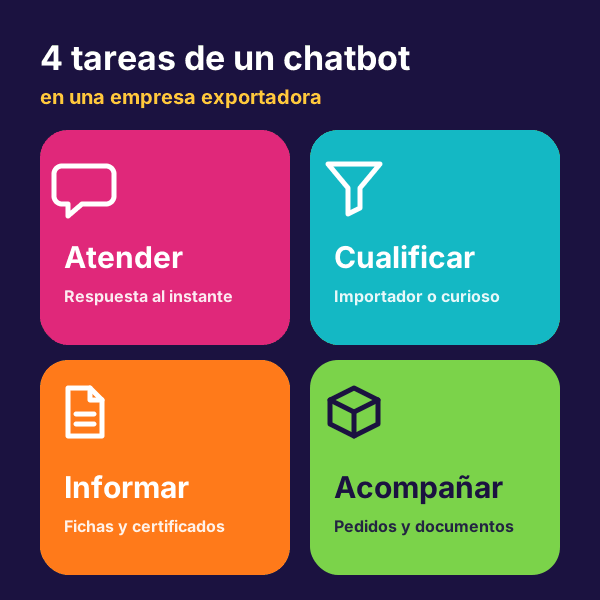
Four tasks where a chatbot genuinely helps
- Responding. It replies instantly, in the customer’s language and at the moment they ask. For example, to the question: “Do you ship to Chile?”
- Qualifying leads. It distinguishes a potential importer from a casual enquirer before you spend an hour on the conversation. Imagine a winery in the Penedès region receiving enquiries from Germany: the assistant responds in German, asks whether the person is an importer, retailer or restaurant, and what annual volume they need. It then passes the contact to the sales representative with a summary. The bot does not close the deal; it prepares the sales call.
- Providing information. It supplies precise details: technical data sheets, certificates, lead times or Incoterms. An industrial components manufacturer can use it to confirm whether its models have a particular certification, refer to the relevant technical data sheet and attach the certificate. If the information is not included in the documentation, the assistant says so and forwards the question to a technician. “I don’t know” is better than an invented answer.
- Supporting customers. It follows up after the sale with order status, documents or replenishment requests. When connected to the order management system and the channel your distributors already use, such as WhatsApp, it moves beyond simply answering questions and starts resolving requests.
There is a fifth option that many companies overlook: building the first chatbot for their own team. An internal assistant that can search quotations, contracts and previous emails helps prevent valuable knowledge from disappearing when an employee leaves. It also allows the team to learn and experiment without the risk of making mistakes in front of a customer.
What Klarna and IKEA can teach us
Two well-known examples demonstrate both the potential and the limitations of this technology.
In 2024, payments company Klarna launched an AI assistant that, according to the company itself, handled two-thirds of customer service chats across 23 markets and 35 languages, reducing resolution times from 11 minutes to 2 minutes. However, in May 2025, its CEO acknowledged that service quality had declined and that the company was hiring people again to serve customers.
IKEA took a different approach. Its Billie chatbot, launched in 2021, handled 47% of enquiries to its customer service centres over a two-year period. Instead of eliminating jobs, the Ingka Group trained 8,500 employees to become interior design advisers. Remote interior design services generated €1.3 billion during its 2022 financial year.
The lesson is clear: chatbots work best when they free up people’s time to sell, rather than trying to replace them.
How to get started without a large budget
You do not need a six-month project. You can progress through three levels:
- Respond: create a company-specific knowledge base on your website or WhatsApp that answers questions and forwards enquiries when necessary.
- Qualify: ask questions, register the contact in your CRM and notify the sales representative.
- Take action: retrieve order information, send documents or prepare draft quotations for a person to review and approve.
There are three main ways to integrate a chatbot into your website: insert a snippet of code provided by the platform, install a plugin for systems such as WordPress, Shopify or PrestaShop, or build a custom integration with your ERP or CRM.
Above all, choose the channel your customers use, not the one you personally prefer. WhatsApp is widely used in Latin America and southern Europe; WeChat is essential in China; LINE is popular in Japan, Taiwan and Thailand; and websites and email remain the foundation of B2B communication across markets.
Five rules to follow before going live
- Never make things up: the chatbot relies on your documentation and refers the enquiry to a person if the information is missing.
- Never make promises: prices, discounts and binding delivery commitments must always be confirmed by a person.
- Do more than translate: a native speaker should review key messages because translation is not the same as localisation.
- Do not collect unnecessary data: request only what is needed and comply with the GDPR.
- Be transparent: clearly state that the customer is interacting with an automated assistant and always offer the option to speak to a person.
To measure results, forget about the number of conversations alone: more conversations may indicate greater interest, or they may mean the bot is not resolving enquiries. Track first-response times by market and time slot, the number of qualified leads passed to sales, transfers to a human representative, and unanswered questions. The latter will become your list of content gaps to address.
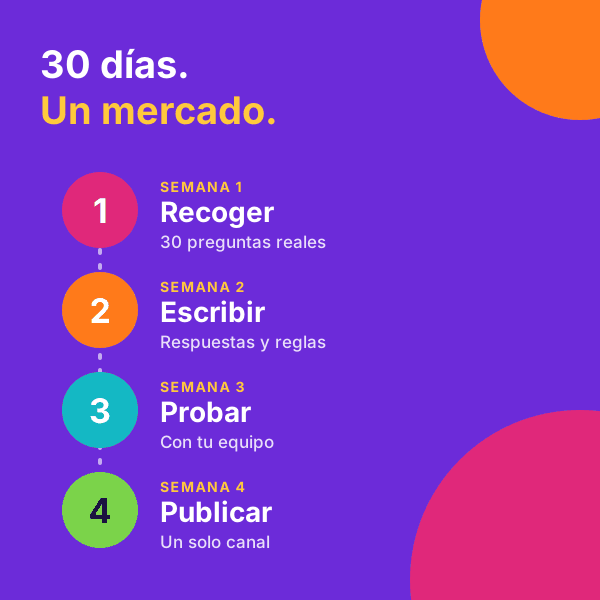
A 30-day plan for a single market
- Week 1 – Collect: gather the 30 real questions customers ask in one specific market. Find them in your emails rather than relying on brainstorming.
- Week 2 – Write: draft the answers and escalation rules with help from the people who know the product.
- Week 3 – Test: test the chatbot with your team and actively try to make it fail.
- Week 4 – Launch: activate it on a single channel and review every conversation.
Most of the work is not technical: it is about writing good answers.
Frequently asked questions
- Does a chatbot replace the sales team? No. It responds to enquiries, qualifies leads and provides information, but commercial decisions, such as prices, discounts and delivery commitments, must always be made by a person.
- What do I need to get started? Your company’s information (technical data sheets, catalogue and commercial terms) and the actual questions your customers ask in a specific market.
- Which channel should I use? Choose the channel your customers already use: your website for B2B in general and, depending on the country, WhatsApp, WeChat or LINE.
You don’t need a chatbot
What you need is to respond better to your international customers. A chatbot is simply a way to do that even at 3 a.m.
If you want to find out how to incorporate one into your export strategy, Barcelona Export can help. Get in touch with us.
[Optional: This article is based on Marc Pericas’s presentation, “Chatbots for Exporting Companies” (The Pericas), delivered as part of the Catalunya Exporta programme.]
Sources: CX Today, Klarna (29 February 2024) · Entrepreneur, Klarna (9 May 2025) · FashionNetwork / Reuters, IKEA (14 June 2023)
This article is based on the talk “Chatbots for Exporting Companies” by Marc Pericas (The Pericas), delivered as part of the Catalunya Exporta programme on 27 October 2026 by Foment del Treball.